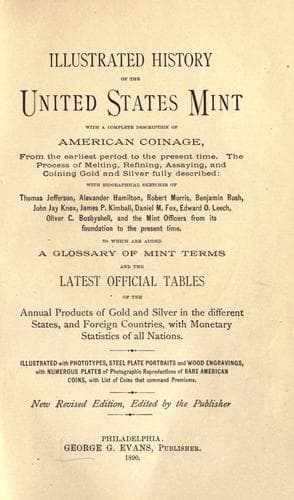
Illustrated history of the United States mint: with a complete description of American coinage, from the earliest period to the present time
History
Illustrated history of the United States mint: with a complete description of American coinage, from the earliest period to the present time
Coinage -- United States; Mints -- United States
For some years prior to 1842, Mr. Eckfeldt and his Assistant,
in addition to their ordinary duties, engaged in the
preparation of an original and comprehensive work on the Coins
of all Nations; on the Varieties of Gold and Silver Bullion; on
Counterfeit Coins, and on other subjects related thereto. This
was published in 1842, and has long been regarded as a standard
authority. In 1850, they issued a supplementary smaller work,
and again in 1852.
As the United States increased in commerce, wealth and
population, the Mint of course increased in work. In
particular, Mexican dollars came in great quantities for
recoinage. Not only were our vaults full, but our entries and
corridors were at times crowded with rows of kegs. Every day,
for years, we had the constant task of sixteen melts of silver
ingots to melt and assay; and it was a great advantage and
satisfaction to be supplied with the _humid_ apparatus.
The success of gold mining in our Southern States, and
the increasing commerce of New Orleans, gave rise to the
establishment of three branch mints at the South, in 1837;
and it devolved upon Mr. Eckfeldt to become schoolmaster, and
educate the three assayers appointed for those places. The same
had to be done again at a later date for other mints and assay
offices.
In December, 1848, came the first lot of gold grains from
California; and with the opening of the next year the tide
set in most powerfully. I shall not here speak of this great
turning-point in metallic currency any further than as it
affected the mint, or rather the labor which it laid upon
Mr. Eckfeldt and his department. As is well known, the lots
were numerous, and the aggregate amount was enormous. Instead
of making gold assays by dozens, we had to go through with
hundreds every day, following the arrival of each steamer.
We procured young men as operators in the weigh-room and
additional workmen in the laboratory; and in spite all the
help we were overworked. Here let me say that the persons who
have been educated by Mr. Eckfeldt to this profession have
done credit to the selection that was made, not only by skill,
diligence, and good character while here, but wherever they are
now scattered to other mints and assay offices, or to different
pursuits.
The gold pressure continued for about five years, when it was
relieved by the creation of a Government assay office in New
York, and a branch mint at San Francisco. But directly sequent
to this came the change of standard in silver coin, causing
an immense recoinage in small pieces. Thus our daily assays
continued to count by hundreds. This lasted for some years.
When it began to slacken off, a law was passed for calling in
the large copper coins and issuing in their stead pieces of
copper-nickel alloy of much smaller size.
Public-domain text, read in full here on John Shaqi.
Reviews
Reviews
No reviews yet
Be the first to share your thoughts on this work.
Elsewhere in the archive
Join the Discussion
Join the discussion
Sign in to leave a comment or review.
Sign InorCreate an account