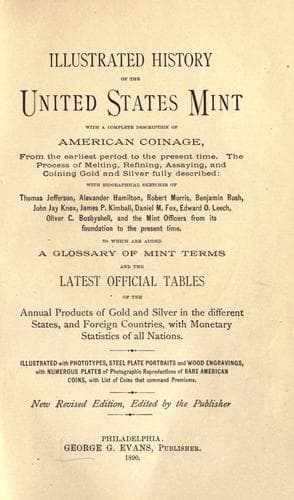
Illustrated history of the United States mint: with a complete description of American coinage, from the earliest period to the present time
History
Illustrated history of the United States mint: with a complete description of American coinage, from the earliest period to the present time
Coinage -- United States; Mints -- United States
Close upon all this, that is to say, in June, 1834, came the
celebrated reduction in the standards of our gold coin, one of
the chief measures of the Jackson administration. This changed
gold from a curiosity to a currency; bullion and foreign
coin flowed to the mint, and accuracy of assay was more than
ever needful. Mr. Eckfeldt was equal to the emergency, and
resolutely introduced reforms, which, at first, made the older
officers stand in doubt.
In those days, about the time the new mint edifice on Chestnut
street was finishing, Mr. Peale was sent to London and Paris
to observe the methods of assaying and refining, and to
procure a new apparatus. We were thus supplied with French
beams, weights, and cupel furnaces, and with the appliances
of Gay-Lussac’s humid assay, and the printed details of the
process. Soon after, Mr. Saxton, famous for his skill in
constructing balances and other delicate instruments, returned
from a long schooling in that line in London, and was employed
in the Mint. Thus furnished, Mr. Eckfeldt felt himself “set
up,” and able to compete with the foreign assayers, and if he
was ever more precise, it was because he disregarded certain
allowances which had become a time-honored custom.
A large importation of fine gold bars from France, known as
the French Indemnity, and which came because President Jackson
declared he “would submit to nothing that was wrong,” gave a
fine opportunity for testing and comparing foreign assays; and
it was generally found that these bars were somewhat below
the alleged fineness. A still more important discovery, was
the fact that British Sovereigns ran below their standard of
fineness. This happened when he had been in office less than
three years, and the Director was unwilling to set the finding
of young Eckfeldt against the experience of Old England.
The Assayer being assured and re-assured of the accuracy of
his results, Director Moore consented to notify the British
Government of their error. The result was a closer scrutiny in
the London Mint, and a final acknowledgement that they were
wrong. This was no less a triumph for Mr. Eckfeldt, than it was
a contribution to exact science, and an honor to the American
Government.
It is not surprising, that he felt at first the inconvenience
of passing from one form of nomenclature to another, though to
a better one. A friend remarks, “I recall conversations with
Mr. Eckfeldt, showing how seriously he felt the revolution. He
would _think_ in carats, and _report_ in decimals. And I often
recur to this as illustrating the kind of difficulties which
would arise in case of a decimalising of weights and measures.”
Public-domain text, read in full here on John Shaqi.
Reviews
Reviews
No reviews yet
Be the first to share your thoughts on this work.
Elsewhere in the archive
Join the Discussion
Join the discussion
Sign in to leave a comment or review.
Sign InorCreate an account