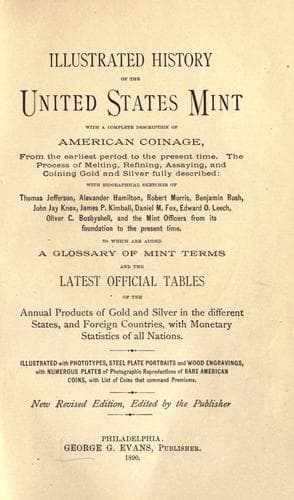
Illustrated history of the United States mint: with a complete description of American coinage, from the earliest period to the present time
History
Illustrated history of the United States mint: with a complete description of American coinage, from the earliest period to the present time
Coinage -- United States; Mints -- United States
Washington, D. C., James P. Kimball, Director of the Mint $4,500
Philadelphia, Pa., Daniel M. Fox, Superintendent 4,500
Boise City, Idaho, Norman H. Camp 2,000
Carson City, Nevada, James Crawford, Superintendent 3,000
Charlotte, N. C., Calvin J. Cowles, Assayer 1,500
Denver, Colorado, Herman Silver, Assayer 2,500
Helena, Montana, Russell B. Harrison, Assayer 2,500
New Orleans, La., Andrew W. Smyth, Superintendent 3,500
New York, N. Y., Andrew Mason, Superintendent 4,500
San Francisco, Cal., Edw. F. Burton, Superintendent 4,500
St. Louis, Mo., Eliot C. Jewett, Assayer 2,500
WILLIAM E. DU BOIS.
Extract from an obituary notice by Robert Patterson.
(Read before the American Philosophical Society, November 18, 1881.)
William Ewing Du Bois was born at Doylestown, Pennsylvania,
December 15, 1810. Through his father, Rev. Uriah Du Bois,
he was descended from Louis Du Bois, a French Huguenot of
honorable extraction, who emigrated to America in 1660,
seeking freedom of religious worship, and, in connection with
others of his countrymen, formed the settlement of New Paltz,
Ulster County, New York. Through his mother, Martha Patterson,
daughter of Professor Robert Patterson, of the University of
Pennsylvania, he inherited the Scotch-Irish element which
has exerted so marked an influence in the development of our
country.
The father of Mr. Du Bois was a Presbyterian clergyman, in
charge of churches in and near Doylestown, and was principal of
the Union Academy at that place, a classical school then and
afterwards of high reputation. He was greatly respected, both
as preacher and teacher.
The bright and studious mind of Mr. Du Bois gathered every
advantage from his opportunities, and he was well furnished in
the classics and mathematics, and in English literature. While
yet a boy he developed a freedom and capacity as a writer quite
remarkable.
His oldest brother was an eminent member of the bar, and it
seemed fitting that Mr. Du Bois should, under his guidance,
adopt the law as his profession. He accordingly pursued the
usual course, in the meantime aiding to support himself by
literary work and conveyancing, and was admitted to practice
in September, 1832. But his health failing him on account of
a bronchial affection, he accepted an appointment in the Mint
at Philadelphia, and thus began the life-work by which his
reputation was established.
Public-domain text, read in full here on John Shaqi.
Reviews
Reviews
No reviews yet
Be the first to share your thoughts on this work.
Elsewhere in the archive
Join the Discussion
Join the discussion
Sign in to leave a comment or review.
Sign InorCreate an account