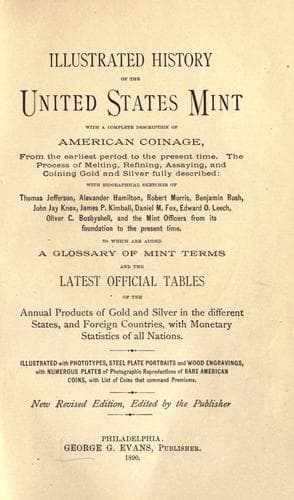
Illustrated history of the United States mint: with a complete description of American coinage, from the earliest period to the present time
History
Illustrated history of the United States mint: with a complete description of American coinage, from the earliest period to the present time
Coinage -- United States; Mints -- United States
Mr. Du Bois entered the Mint in September, 1833, and was
first employed in the office of the Director, Dr. Moore. In
1835, at the request of the Assayer, Mr. Jacob R. Eckfeldt,
he was transferred to a more congenial position in the assay
department. Here he continued for the remainder of his life. In
1836 he was appointed Assistant Assayer. In September, 1872, he
succeeded Mr. Eckfeldt as Assayer, and remained at the head of
the department until his death, July 14, 1881, thus completing
nearly forty-eight years of Mint service.
Mr. Du Bois early took rank as an accomplished assayer, and
long before his death had reached the head of his profession.
The close intimacy between Mr. Du Bois and Mr. Eckfeldt
developed into warm friendship. The tie was made closer by
the marriage of Mr. Du Bois, in 1840, to Susanna Eckfeldt,
the sister of his chief. I shall have to speak of published
works and scientific communications appearing under the names
of Eckfeldt and Du Bois. Although it was understood that Mr.
Du Bois was the sole literary author, yet no separate claim
of authorship was made by either. Whatever of reputation was
earned, each was contented that it might be shared by the
other, and jealousy never for a moment weakened a union that
bound them for life.
In the year 1834 a change took place in the ratio of gold to
silver in the standard of U. S. coins, the effect of which
was to bring large deposits of gold to the Mint. The coinage
previously had been chiefly of silver. The more equal supply of
the precious metals gave active employment in the assay of each
of them, and was, of course, most valuable as an experience
to Mr. Du Bois, who about this time became connected with the
assay department.
In 1837, on revision of the Mint laws and standards brought
about by Dr. Robert M. Patterson, then Director, a reform was
effected in the method of reporting assays, the millesimal
system taking the place of the time-honored but cumbrous
method of carats and grains. About this time, also, the older
plan of assaying silver was abandoned, the humid assay being
substituted, and largely worked under the direct supervision of
Mr. Du Bois.
About 1838 branch mints were organized in the States of
Louisiana, Georgia, and North Carolina. The labors and
responsibilities of the Philadelphia assay department were
increased by this development, partly from the necessity of
instructing assayers for the new branches, and partly in
testing the correctness of the assays made there.
Public-domain text, read in full here on John Shaqi.
Reviews
Reviews
No reviews yet
Be the first to share your thoughts on this work.
Elsewhere in the archive
Join the Discussion
Join the discussion
Sign in to leave a comment or review.
Sign InorCreate an account