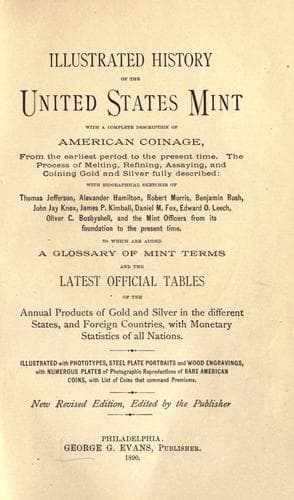
Illustrated history of the United States mint: with a complete description of American coinage, from the earliest period to the present time
History
Illustrated history of the United States mint: with a complete description of American coinage, from the earliest period to the present time
Coinage -- United States; Mints -- United States
The writings of Mr. Du Bois were numerous, and continued up to
the year of his death. His papers on numismatics were frequent
and always attractive, his last appearance in print being
in April of this year, in an article on the “Coinage of the
Popes.” To the “American Philosophical Society,” of which he
was elected a member in 1844, he made various communications on
behalf of Mr. Eckfeldt and himself, mostly on topics suggested
by experiences in the assay department. Among the most curious
was one on “The Natural Dissemination of Gold,” by which we
were astonished to learn that this precious metal is found in
appreciable quantity in the clays underlying our city.
In 1869 he wrote for the “Bankers’ Magazine,” “Propositions
for a Revised System of Weights, and a Restoration of Silver
Currency.” The development of his views on these subjects
is a model of clear exposition, and the conclusions reached
were such as might be expected from a mind aiming to attain
practical results rather than to impose visionary theories.
From the beginning he was highly esteemed at the Mint. It was
his ambition to acquire a knowledge of every branch of the
service, and with his capacity and opportunities this end was
attained. He early became the trusted friend and counsellor
of his colleagues, and was able to serve them in many ways,
perhaps most of all with his ready pen. As time passed, and
forty-eight years of experience was given to him, he was
recognized by all as the Nestor of the Mint service. And here I
pause to draw a lesson, from the example of Mr. Du Bois’s life,
as to the value of a properly organized civil service. In the
department with which he was connected, political tests were
never obtruded, and permanence of tenure followed on merit.
On no other basis could his services have been claimed or
retained. They would have been transferred to a private sphere,
probably to his pecuniary gain, certainly to the public loss.
He was very accessible, and ever ready to lend aid from the
stores of his knowledge, but in particular did he delight to
instruct and bring forward his younger friends.
Mr. Du Bois was able to fulfill his official duties until
within a few months of his death. He was fully conscious of his
approaching end, preserving his intelligence to the last, and
the faith which had comforted him in this life supported him at
its close.
The following minute was adopted at a meeting of the officers
and employees after his decease:
Public-domain text, read in full here on John Shaqi.
Reviews
Reviews
No reviews yet
Be the first to share your thoughts on this work.
Elsewhere in the archive
Join the Discussion
Join the discussion
Sign in to leave a comment or review.
Sign InorCreate an account