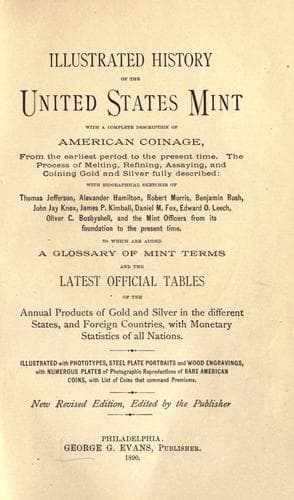
Illustrated history of the United States mint: with a complete description of American coinage, from the earliest period to the present time
History
Illustrated history of the United States mint: with a complete description of American coinage, from the earliest period to the present time
Coinage -- United States; Mints -- United States
In 1848 the great discovery of gold in California was made
known. This brought a tremendous pressure on every department
of the Mint, and not the least on the assayers. The gold
coinage was, in three years, raised from a little over three
million dollars to more than sixty-two millions. The assays
were often counted by hundreds in a day. But whatever the
pressure in the office, accuracy ruled, and the correctness of
the assays was never impeached.
In 1853 a change was effected in the law for providing
subordinate silver coins. This brought about, for some years
succeeding, an unprecedented coinage of that metal, and still
further increased the labors of the assay department.
He instituted the Cabinet of coins which now adorns the Mint.
This was commenced in 1838. A small annual appropriation
was procured from Congress for this purpose, and the work
of collection committed entirely to Mr. Du Bois. He brought
to it all the enthusiasm which animates most numismatists,
sobered, however, by good judgment. His expenditures were
always judicious. Some of the best of the specimens were culled
from the Mint deposits for the bullion value, merely, of the
pieces. After the collection had taken good shape, and been
well classified, he wrote and published, in 1846, a description
of it, under the title “Pledges of History,” etc. The title
thus selected intimated his opinion as to the real value of
such collections. He thought that a coin should be prized for
its historical teaching, or artistic merit, and discouraged the
rage to possess a piece simply because of its rarity. Mr. Du
Bois acted as curator of the Cabinet until his death.
Another important labor undertaken by Mr. Du Bois (in
connection with Mr. Eckfeldt) was the preparation and
publication, in 1842, of a “Manual of the Gold and Silver Coins
of all nations, struck within the past century.” This was a
work of very great labor, and, from its expense, of some risk
also to the authors. It is admirably arranged, the information
clear, and it embraced every subject of interest at that
date as to coins, bullion, counterfeits, etc. Subsequently,
in 1850 and 1851, supplements were published covering later
topics, made prominent in consequence of the California gold
discoveries.
Public-domain text, read in full here on John Shaqi.
Reviews
Reviews
No reviews yet
Be the first to share your thoughts on this work.
Elsewhere in the archive
Join the Discussion
Join the discussion
Sign in to leave a comment or review.
Sign InorCreate an account