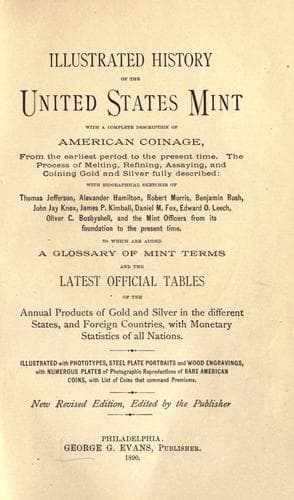
Illustrated history of the United States mint: with a complete description of American coinage, from the earliest period to the present time
History
Illustrated history of the United States mint: with a complete description of American coinage, from the earliest period to the present time
Coinage -- United States; Mints -- United States
NATHANIEL B. BOYD, Assistant Melter and Refiner, was born in
Philadelphia, January, 1832. Twenty years later, he was graduated with
honors at Burlington College. After leaving College he studied law, and
was admitted to the Philadelphia Bar in 1854. In 1869 he accepted an
appointment in the National Mint, tendered him by Director Pollock. In
1873 he was appointed Assistant Melter and Refiner, a position which he
still occupies (1885).
THE MINT ENGRAVERS.
(Extract from Patterson Du Bois’ Biographical Sketch of “Our Mint
Engravers.”)
Whatever may be said concerning the peculiar responsibilities of the
officers of the Mint, who are occupied with the various operations of
turning bullion into coin, it must be conceded that none of them occupies
a position so dubious and, in some ways, so unenviable as the Engraver.
In the general transactions of the Mint, he is the most retired—the most
obscure—of its officers; yet his card is in every one’s pocket.
As to the types of coinage, the standards are as numerous as the eyes
that water for them, and there is no piece but may be said to be outside
of _somebody’s_ tolerance. No other artist undergoes such an ordeal, for
those who do not admire this painting or that statue are not compelled to
hug and hoard it, much less to toil for its possession. The engraver who
can, from his retired window, see the critical millions clutching for his
little _relievos_, is in some sort a hero _ex-officio_, and it has been
well suggested that we look briefly upon the uneventful lives of this
worthy line of officers.
I. Robert Scot received his appointment as the first Engraver of the
Mint, November 23, 1793. Information is wanting as to his nativity,
but at the time of his appointment he seems to have been turning the
down-hill of life. He is remembered as rather under size, and as an
honorable and agreeable gentleman.
According to Loubat, Joseph Wright was “appointed first a draughtsman
and die-sinker to the United States Mint, and made the dies of a medal,
the bust on the obverse of which was considered to be the best medallic
profile likeness of Washington.[21] He also made the medal voted by
Congress to Major Lee.” Wright died in 1793.
II. William Kneass, second of the line, was born in Lancaster, Pa.,
September, 1781, and was appointed Engraver January 29, 1824. Mr. Kneass
had been chiefly a plate engraver for book-work. There were some changes
in the coinage during his term, notably in 1834 and 1838, for gold, and
1836, 1837, 1838, and 1840, for silver. But some of this work was done by
Gobrecht as assistant. Kneass appears upon a pattern half dollar of 1838;
but the silver dollar of 1836, as well as a pattern half of 1838, were
the work of his assistant. Prior to his appointment he had an engraving
office on Fourth above Chestnut street, Philadelphia, which was a
well-known rendezvous for the leading wits and men of culture, for which
Philadelphia was then eminent.
Public-domain text, read in full here on John Shaqi.
Reviews
Reviews
No reviews yet
Be the first to share your thoughts on this work.
Elsewhere in the archive
Join the Discussion
Join the discussion
Sign in to leave a comment or review.
Sign InorCreate an account