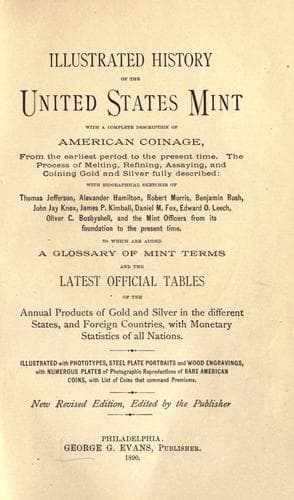
Illustrated history of the United States mint: with a complete description of American coinage, from the earliest period to the present time
History
Illustrated history of the United States mint: with a complete description of American coinage, from the earliest period to the present time
Coinage -- United States; Mints -- United States
Mr. Kneass died in office, August 27, 1840. A good engraving of him hangs
in the Assayer’s Office, inscribed “to his friend Adam Eckfeldt, Chief
Coiner,”—who had been chiefly instrumental in securing his appointment.
III. Christian Gobrecht was appointed December 21, 1840, to fill the
vacancy made by the death of Kneass. He was born in Hanover, York Co.,
Pa., December 23, 1785. In 1811 he went to Philadelphia, and became an
engraver of bank notes, seals, calico printers’ rolls, bookbinders’ dies,
etc. In 1836 he received an appointment as assistant to Mr. Kneass at
the Mint, in which capacity he executed some important work. Among other
similar performances he was highly commended for his Franklin Institute
Medal.
Christian Gobrecht continued in office until his death, July 23, 1844.
IV. James B. Longacre was born August 11, 1794, in Delaware Co., Pa.
He served an apprenticeship as a line engraver with George Murray,
Philadelphia, and did some high class plate-work before he was free, in
1819. He was one of the originators of the _National Portrait Gallery of
Distinguished Americans_, the first volume of which appeared in 1834.
Longacre drew from life and engraved many of the portraits entire.
Like his predecessors, he died in office—January 1, 1869. During his
term Mr. Longacre was variously assisted by P. F. Cross, William Barber,
Anthony C. Paquet, and William H. Key. Cross was born in Sheffield,
England, served several years in the Mint here, and died in 1856. He
engraved the obverse of the Ingraham medal. Paquet was born in Hamburg,
1814, emigrated 1848, served as assistant 1857 to 1864, died, 1882.
He engraved the medals of Grant, Johnson, Buchanan, Everett, and the
Life Saving Medals, with some others. Key is a native of Brooklyn, was
appointed an assistant, 1864, and is still in the service. He executed
the Kane Expedition and Archbishop Wood Medals. The changes and additions
during the Longacre term were numerous and important, both as to alloys
and denominations. The pattern pieces also record various experiments in
the art of coining.
V. William Barber, fifth Engraver of the Mint, was born in London, May
2, 1807. He learned his profession from his father, John Barber, and was
employed on silver-plate work, after his emigration to this country.
He resided in Boston ten years, and was variously employed in his line
of work. His skill in this way came to the knowledge of Mr. Longacre,
then Engraver of the Mint, and he secured his services as an assistant in
1865.
In January, 1869, upon the death of Mr. Longacre, he was appointed as his
successor, and continued in that position for the remainder of his life.
His death, which resulted from severe chills, brought on by bathing at
the seashore, occurred in Philadelphia, August 31, 1879.
Public-domain text, read in full here on John Shaqi.
Reviews
Reviews
No reviews yet
Be the first to share your thoughts on this work.
Elsewhere in the archive
Join the Discussion
Join the discussion
Sign in to leave a comment or review.
Sign InorCreate an account