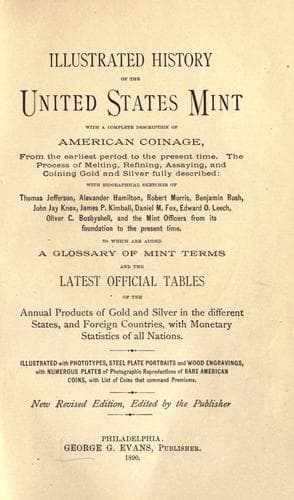
Illustrated history of the United States mint: with a complete description of American coinage, from the earliest period to the present time
History
Illustrated history of the United States mint: with a complete description of American coinage, from the earliest period to the present time
Coinage -- United States; Mints -- United States
Besides much original work on pattern coins, he also produced over forty
medals, public and private. The work on all of them was creditable, but
we may specify those of Agassiz, Rittenhouse, and Henry, as very superior
specimens of art. Mr. Barber was assisted by Mr. William H. Key, Mr.
Charles E. Barber, and Mr. George T. Morgan.
VI. Charles E. Barber, sixth Engraver, is a son of the preceding, and was
born in London in 1840. He was appointed an assistant in 1869, and became
the official head by promotion in 1880, to fill the vacancy caused by his
father’s death. The appointment was not unmerited. One of Mr. Barber’s
latest cards to the public is the new five-cent piece—a successful
venture in very low relief. But his handiwork is more or less visible in
all the principal medals executed since 1869. Since his appointment as
Chief Engraver, the work of his department has been enormously increased
by the number of medal dies demanded for the War Department and from
other Government sources. Mr. Barber’s best work is seen in the medals of
Presidents Garfield, Arthur, Indian Peace, Army Marksmanship, and Great
Seal. He is particularly happy in “catching a likeness.” The head of
Superintendent Snowden is a rare specimen of medallic portraiture.[22]
Messrs. Key and Morgan are the Engraver’s assistants. The former has
already received notice; the latter, Mr. George T. Morgan, was born in
Birmingham, England, in 1845; he studied at the Art School there, and won
a National Scholarship at the South Kensington, where he was a student
two years. He is best known to the country by the so-called “Bland
dollar,” which is his design and execution.
We have reason to congratulate both the Government and the people that
the engraving service is well and judiciously furnished.
BENJAMIN RUSH,
An eminent physician and philanthropist, was born near Philadelphia,
December 24, 1745; he graduated from Princeton College in 1760; he
afterwards studied medicine in Edinburgh, London, and Paris; returning
to this country, he was elected Professor of Chemistry in the Medical
College of Philadelphia in 1769. In 1776 he was elected to the
Continental Congress, and was one of the signers of the Declaration
of Independence in the same year; he was afterwards appointed
Surgeon-General of Revolutionary Army, and voted for the adoption of
the Constitution of the United States in 1787. Dr. Rush was a popular
lecturer, and eminently qualified as a teacher of medicine. When the
yellow fever scourged the City, and the public buildings were closed in
1799 and 1800, he was very successful in his treatment of the victims
of that epidemic. It is said that he visited and prescribed for one
hundred patients in a single day. He was treasurer of the first United
States Mint during the last fourteen years of his life. Dr. Rush died in
Philadelphia in April, 1813. Among his nine children was Richard Rush,
the statesman.
Public-domain text, read in full here on John Shaqi.
Reviews
Reviews
No reviews yet
Be the first to share your thoughts on this work.
Elsewhere in the archive
Join the Discussion
Join the discussion
Sign in to leave a comment or review.
Sign InorCreate an account