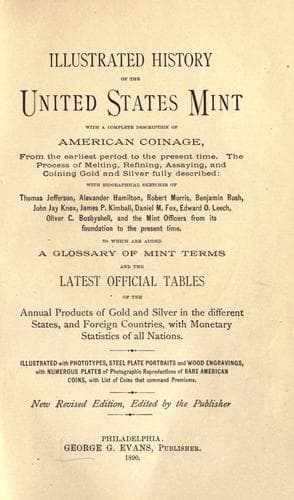
Illustrated history of the United States mint: with a complete description of American coinage, from the earliest period to the present time
History
Illustrated history of the United States mint: with a complete description of American coinage, from the earliest period to the present time
Coinage -- United States; Mints -- United States
The earliest series of standard weights now known, are two sets
discovered by Mr. Layard in the ruins of Nineveh. They are now in the
British Museum. William the Conqueror decreed the continuance, as the
legal standard, of the pound in use by the Saxons. This and other
standards of weight and measure were removed by the King from the City of
Winchester to the Exchequer at Westminster, and placed in a consecrated
building in charge of his chamberlains. The place of deposit is said
to have been the crypt chapel of Edward the Confessor, in Westminster
Abbey. In 1866 the office of Exchequer was abolished, and the Standards
Department of the Board of Trade was established in London, assuming
charge of the standards—an arrangement still in force.
The old Saxon pound was the earliest standard of England. It was
identical in weight with the old apothecaries’ pound of Germany,
and equal to 5,400 of our later Troy grains. The pound sterling was
determined from this weight in silver. Henry III., in 1266, decreed the
following standards: The sterling, or penny, to weigh equal to thirty-two
wheat corns, taken from the middle of the ear; twenty pence, one ounce;
twelve ounces, one pound; eight pounds, one gallon of wine, which is
the eighth part of a quarter. The idea of the grain was borrowed by the
English from the French, and the Black Prince brought back with him from
France the pound Troye, which was derived from the commercial town of
that name. The use of the Troy standard was adopted by the druggists and
jewelers, on account of its convenient reduction into grains.
The pound avoirdupois, weighing 7,000 grains Troy, (Fr. _Avoir-du-poids_,
“to have weight”), first appears in use during the reign of Edward III.,
and it, as well as the Troy pound, has been employed without change ever
since. In the year 1834 the English standards of weight and measure,
consisting of a yard and pound Troy of brass, were destroyed by fire at
the burning of the Houses of Parliament. A few years later a commission
of scientific men was appointed to determine upon the restoration of
the standards. This resulted in a succession of difficult problems
resultant upon the oxidation to a greater or less extent of duplicates
of the standard still existing, as also of the variation of the cubic
inch of water, as in use in different lands. A cubic inch of distilled
water, weighed in air against brass weights, at a temperature of 62
degrees Fahr., the barometer being at 30 inches, had been determined by
scientific men to be equal to 252.458 grains, of which the standard Troy
pound contained 5,760.
Public-domain text, read in full here on John Shaqi.
Reviews
Reviews
No reviews yet
Be the first to share your thoughts on this work.
Elsewhere in the archive
Join the Discussion
Join the discussion
Sign in to leave a comment or review.
Sign InorCreate an account