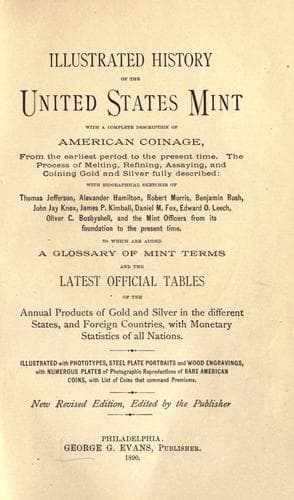
Illustrated history of the United States mint: with a complete description of American coinage, from the earliest period to the present time
History
Illustrated history of the United States mint: with a complete description of American coinage, from the earliest period to the present time
Coinage -- United States; Mints -- United States
As the unit of length was also lost, a series of experiments was made in
the vibration of a pendulum in a vacuum, marking seconds of mean time
in the latitude of London at the level of the sea. These deductions,
however, failed to be satisfactory, and the commission was compelled to
fall back upon the best preserved of the duplicate standards existent.
The Imperial Standard Pound is declared to be the true weight of an
avoirdupois pound in a vacuum. It is a curious fact that the Imperial
standards of platinum (which metal is not subject to oxidation), although
balancing brass weights in a vacuum, weigh in air more than one-half a
grain heavier than the latter. This is due to their greater displacement
of space.
The unit of weight in the United States is a Troy pound weight obtained
from England, a duplicate of the original standard fixed by the
commission of 1758, and reasserted by the commission of 1838. It is a
bronze weight of 5,760 grains Troy. It is kept in a strong safe at the
United States Mint, in Philadelphia. The President appoints an assay
commission, whose members meet at Philadelphia annually, upon the second
Wednesday in February, open the safe, and compare the copies, or the
working weights, with the original upon the most delicately poised
balances. Working standards of weights and measures are supplied by the
Secretary of State to the State governments, which in turn supply them to
the sealers of weights and measures of the various countries, who must
compare with the State standard once a year.
[Illustration: TROY STANDARD POUND WEIGHT.
Fac-simile, exact size.]
All of the scales and delicate test instruments in use by the government,
not only in Philadelphia Mint, but at the several branch mints, are
manufactured in this country, and as examples of wonderful mechanical
machines of minute accuracy they lead the world. Some of them are the
work of Mr. Henry Troemner, of Philadelphia, to whom, it is proper to
say, the writer is largely indebted for the facts given in this article.
Mr. Troemner, in the capacity of government expert, makes frequent visits
to the most distant points in the Union for the verification of national
standards. The Treasury Department made an especial request of him to
exhibit at the New Orleans Exposition, a line of his fine balances.
EXTRACT FROM CONSTITUTION OF THE UNITED STATES.
ARTICLE I., Sect. 8. The Congress shall have power ... to coin
money, regulate the value thereof and of foreign coins, and fix
the standard of weights and measures, ... to provide for the
punishment of counterfeiting the securities and current coin of
the United States.
ARTICLE I. Sect. 2. No State shall ... coin money, emit bills
of credit, make anything but gold and silver coin a tender in
payment of debts, ...
Coinage, fiscal year 1887.
Public-domain text, read in full here on John Shaqi.
Reviews
Reviews
No reviews yet
Be the first to share your thoughts on this work.
Elsewhere in the archive
Join the Discussion
Join the discussion
Sign in to leave a comment or review.
Sign InorCreate an account