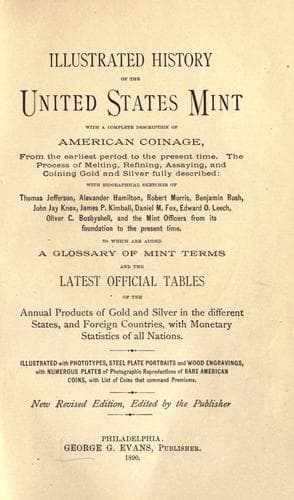
Illustrated history of the United States mint: with a complete description of American coinage, from the earliest period to the present time
History
Illustrated history of the United States mint: with a complete description of American coinage, from the earliest period to the present time
Coinage -- United States; Mints -- United States
The following is a test for determining whether coin is good or bad.
Use the liquids as near the edge of suspected coin as possible, as that
is the part most worn. A drop of the preparation will have no effect on
genuine coin, while it can be plainly seen on the counterfeit. Coins
should be scraped slightly before using:
TEST FOR GOLD.
Strong Nitric Acid (36°), 39 parts.
Muriatic Acid, 1 part.
Water, 20 parts.
TEST FOR SILVER.
24 grains Nitre of Silver.
30 drops Nitric Acid.
1 ounce Water.
The above tests should be taken in conjunction with _Diameter_,
_Thickness_, and _Weight_, the tests used at the Mint.
GLOSSARY.
_Terms used in treating of Bullion, Mints, Coinage, and Money._
ASSAYING.—Chemical analysis of metals or ores. This term is employed in
reference to mints and coinage, refers particularly to the process for
determining the component parts and relative proportions of a mixed alloy
of gold and silver, or the various alloys used for the manufacture of
minor coins.
REFINING.—Extract of base from precious metals; usually performed by the
aid of heat and oxidizing fluxes.
PARTING.—The separation of gold and silver when the two metals
compose an alloy, either native or artificial, for the purpose of
obtaining the metals, respectively, in the form of fine bars. This is
accomplished, first, by dissolving the silver with acids and subsequently
precipitating; or, second, by converting silver into chloride by heat and
chlorine gas, and then reducing the chloride to a metallic state.
ALLOYING.—Compounding two or more metals together in suitable or legal
proportions for coinage. Gold and silver are alloyed with copper for
standard coins, and alloys are variously made of nickel and copper, or of
copper, tin, and zinc for minor coins.
FINE BARS.—Gold and silver bars resulting from the operations of parting
and refining. Bars containing 99 per cent. of pure metal are generally
considered as fine bars.
UNPARTED BULLION.—Gold containing silver or silver containing gold which
has not been subjected to the parting operation.
AMALGAM.—Gold and silver extracted from ores or other substances by the
use of mercury and left in a porous or spongy condition, when the mercury
is removed by distillation.
FINENESS.—A term indicating the proportion of pure metal contained in a
piece of gold or silver. Fineness is expressed in thousandths; that is,
pure metal is 1000. United States coin is ⁹⁰⁰⁄₁₀₀₀ fine, or decimally
.900 fine. Fineness is estimated by jewelers and workers in the precious
metals by “carats,” pure metal being 24 carats. Thus 22 carats, the
British standard for gold coins, is ²²⁄₂₄, or decimally, 916⅔ fine.
DEPOSIT—MELTING.—The operation of melting a deposit of gold or silver
at the Mint to secure a homogeneity of metals, preliminary to taking a
sample for assaying.
REMEDY OF THE MINT.—The legal variation allowed from the fineness and
weight prescribed by law for the coins.
Public-domain text, read in full here on John Shaqi.
Reviews
Reviews
No reviews yet
Be the first to share your thoughts on this work.
Elsewhere in the archive
Join the Discussion
Join the discussion
Sign in to leave a comment or review.
Sign InorCreate an account