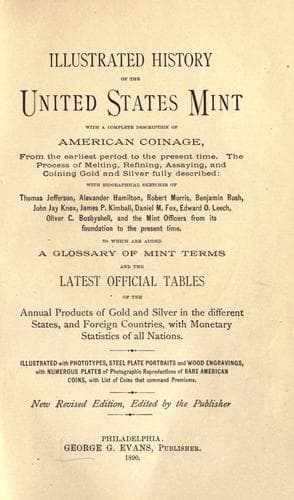
Illustrated history of the United States mint: with a complete description of American coinage, from the earliest period to the present time
History
Illustrated history of the United States mint: with a complete description of American coinage, from the earliest period to the present time
Coinage -- United States; Mints -- United States
TRIAL OF THE PYX.—The annual test made by special commissioners of the
fineness and weight of coins reserved from each delivery of coin by the
coiner to the superintendent. These coins are known as Pyx coins, because
kept in a pyx or chest.
REFRACTORY BULLION.—Gold or silver bullion which contains a small
percentage of lead, tin, or antimony, and which is therefore too hard or
brittle to roll, cut, or stamp with facility.
WASTAGE.—The amount of gold and silver lost in the processes which these
metals undergo preparatory to striking the coins. This “wastage” by law
must not exceed a certain percentage of the gross amount of metals worked.
SWEEPINGS.—The ashes, fluxes, crucibles, sweepings, and all other refuse
materials from rooms in which the metals are worked, containing a small
amount of gold and silver.
STANDARD.—The weight and fineness fixed by law for the coins; hence the
term “standard weight” or “standard fineness.”
BASE BULLION.—Gold or silver bullion not fit for coinage purposes, by
reason of the presence of base metals, until refined.
MINT MARK.—The letter or mark on the coin, designating the mint at which
it was struck; as “S” for San Francisco, “C C” for Carson City, “O” for
New Orleans.[30]
MONEY OF ACCOUNT.—The ideal unit, or money term, in which accounts are
stated or transactions made, as the _pound sterling_ of Great Britain,
the _dollar_ of the United States, the _franc_ of France, and the
_reichsmark_ of the German Empire.
COINS OF STANDARD VALUE.—In modern times a government first establishes
a money of account or ideal unit, and then fixes by law the quantity
of gold or silver which shall, in the form of a coin with unlimited
legal-tender power, represent that ideal unit. Such coins, with their
multiples and divisions, are termed “coins of standard value” or
“standard coins.”
SUBSIDIARY COINS.—In the United States silver coins of less denomination
than the dollar, which have a nominal value exceeding their intrinsic or
bullion value, and limited as legal tender to sums not exceeding five
dollars.
MINOR COINS.—Coins of small denominations used for change, and struck
from other metals than gold or silver.
MINT PRICES OF GOLD AND SILVER (COINING VALUE).—The rate per standard
ounce at which the mint converts bullion into legal-tender coins. The
coining rate of an ounce of standard gold bullion, _i. e._, bullion
⁹⁰⁰⁄₁₀₀₀ fine in the United States is $18,604+. The coining rate of the
silver dollar of 412½ grains, discontinued by law April 1, 1873, was
$1.16⁴⁄₁₁ per standard ounce.
THE BASIS OF THE MONEY SYSTEM of all civilized nations is gold or silver,
or both, in a ratio fixed by law. The relative valuation of the two
metals in the coins of nations using the double standard, is about one of
gold to _fifteen and a half of silver_.
_Partial List of Medals in Copper-Bronzed, also, in Gold and Silver,
which may be obtained at the Mint._
Public-domain text, read in full here on John Shaqi.
Reviews
Reviews
No reviews yet
Be the first to share your thoughts on this work.
Elsewhere in the archive
Join the Discussion
Join the discussion
Sign in to leave a comment or review.
Sign InorCreate an account