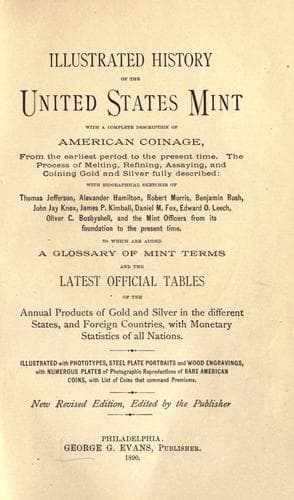
Illustrated history of the United States mint: with a complete description of American coinage, from the earliest period to the present time
History
Illustrated history of the United States mint: with a complete description of American coinage, from the earliest period to the present time
Coinage -- United States; Mints -- United States
The first coinage of the United States, was silver half-dimes in October,
1792, of which Washington makes mention in his address to Congress, on
November 6, 1792, as follows; “There has been a small beginning in the
coinage of half-dimes; the want of small coins in circulation, calling
the first attention to them.” The first metal purchased for coinage was
six pounds of old copper at one shilling and three pence per pound, which
was coined and delivered to the Treasurer, in 1793. The first deposit
of silver bullion was made on July 18, 1794, by the Bank of Maryland.
It consisted of “coins of France,” amounting to $80,715.73½. The first
returns of silver coins to the Treasurer, was made on October 15, 1794.
The first deposit of gold bullion for coinage, was made by Moses Brown,
merchant, of Boston, on February 12, 1795; it was of gold ingots, worth
$2,276.72, which was paid for in silver coins.
The first return of gold coinage, was on July 31, 1795, and consisted of
744 half eagles. The first delivery of eagles was in September 22, same
year, and consisted of four hundred pieces.
Previous to the coinage of silver dollars, at the Philadelphia Mint, in
1794, the following amusing incidents occurred in Congress, while the
emblems and devices proposed for the reverse field of that coin were
being discussed.
A member of the House from the South bitterly opposed the choice of
the eagle, on the ground of its being the “king of birds,” and hence
neither proper nor suitable to represent a nation whose institutions and
interests were wholly inimical to monarchical forms of government. Judge
Thatcher playfully, in reply, suggested that perhaps a goose might suit
the gentleman, as it was a rather humble and republican bird, and would
also be serviceable in other respects, as the goslings would answer to
place upon the dimes. This answer created considerable merriment, and the
irate Southerner, conceiving the humorous rejoinder as an insult, sent
a challenge to the Judge, who promptly declined it. The bearer, rather
astonished, asked, “Will you be branded as a coward?” “Certainly, if he
pleases,” replied Thatcher; “I always was one and he knew it, or he would
never have risked a challenge.” The affair occasioned much mirth, and,
in due time, former existing cordial relations were restored between the
parties; the irritable Southerner concluding there was nothing to be
gained in fighting with one who fired nothing but jokes.
EXTRACT FROM THE RULES AND REGULATIONS ADOPTED FOR THE MINT, JANUARY 1,
1825.
Public-domain text, read in full here on John Shaqi.
Reviews
Reviews
No reviews yet
Be the first to share your thoughts on this work.
Join the Discussion
Join the discussion
Sign in to leave a comment or review.
Sign InorCreate an account