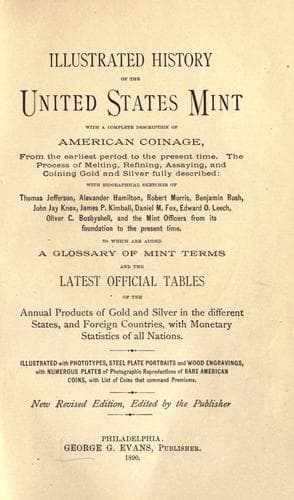
Illustrated history of the United States mint: with a complete description of American coinage, from the earliest period to the present time — John Shaqi
Illustrated history of the United States mint: with a complete description of American coinage, from the earliest period to the present time
History
Illustrated history of the United States mint: with a complete description of American coinage, from the earliest period to the present time
Coinage -- United States; Mints -- United States
The watchman of the Mint must attend from 6 o’clock in the
evening to 5 o’clock in the morning, and until relieved by
the permission of an officer, or until the arrival of the
door-keeper. He will ring the yard bell precisely every hour
by the Mint clock, from 10 o’clock until relieved by the
door-keeper, or an officer, or the workmen on working days,
and will send the watch dog through the yard immediately after
ringing the bell. He will particularly examine the departments
of the engine and all the rooms where fire has been on the
preceding day, conformably to his secret instructions. For this
purpose he will have keys of access to such rooms as he cannot
examine without entering them.
If an attempt be made on the Mint he will act conformably
to his secret instructions on that subject. In case of fire
occurring in or near the Mint, he will ring the Alarm Bell if
one has been provided, or sound the alarm with his rattle,
and thus as soon as possible bring some one to him who can be
dispatched to call an officer, and in other particulars will
follow his secret instructions. The secret instructions given
him from time to time he must be careful not to disclose. The
delicate trust reposed in all persons employed in the Mint,
presupposes that their character is free from all suspicion,
but the director feels it his duty nevertheless, in order
that none may plead ignorance on the subject, to warn them
of the danger of violating so high a trust. Such a crime as
the embezzlement of any of the coins struck at the Mint, or
of any of the metals brought to the Mint for coinage, would
be punished under the laws of Pennsylvania, by a fine and
penitentiary imprisonment at hard labor. The punishment annexed
to this crime by the laws of the United States, enacted for the
special protection of deposits made at the Mint, is DEATH. The
19th Section of the Act of Congress, establishing the Mint,
passed April 12, 1792, is in the following words: Section 19,
_and_ be it further enacted, That if any of the gold or silver
coins, which shall be struck or coined at the said Mint, shall
be debased or made worse as to the proportion of fine gold or
fine silver, therein contained, or shall be of less weight or
value than the same ought to be, pursuant to the directions of
this act, through the default or with the connivance of any of
the officers or persons who shall be employed at said Mint, for
the purpose of profit or gain, or otherwise, with a fraudulent
intent, and if any of the said officers or persons shall
embezzle any of the metal which shall at any time be committed
to their charge, for the purpose of being coined, or any of
the coins which shall be struck or coined at the said Mint,
every such officer or person who shall commit any or either of
Public-domain text, read in full here on John Shaqi.
Reviews
Reviews
No reviews yet
Be the first to share your thoughts on this work.
Join the Discussion
Join the discussion
Sign in to leave a comment or review.
Sign InorCreate an account