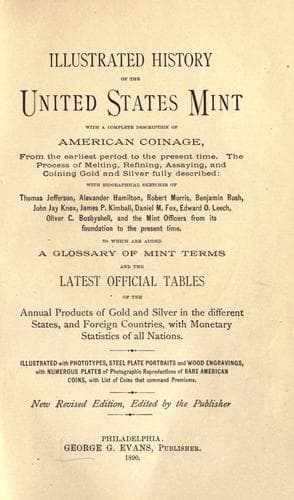
Illustrated history of the United States mint: with a complete description of American coinage, from the earliest period to the present time
History
Illustrated history of the United States mint: with a complete description of American coinage, from the earliest period to the present time
Coinage -- United States; Mints -- United States
The Mint was established by Act of Congress the second of April, 1792,
and a few half-dimes were issued towards the close of that year. The
general operations of the institution commenced in 1793. The coinage
effected from the commencement of the establishment to the end of the
year 1800 may be stated in round numbers at $2,534,000; the coinage
of the decade ending 1810 amounted to $6,971,000, and within the ten
years ending with 1820—$9,328,000. The amount within the ten years
ending with 1830 is stated at $18,000,000, and the whole coinage from
the commencement of the institution at $37,000,000. On the second of
March, 1829, provisions were made by Congress for extending the Mint
establishment, the supply of bullion for coinage having increased beyond
the capacity of the existing accommodations. The Mint edifice, erected
under this provision, stands on a lot purchased for the object at the
northwest corner of Chestnut and Juniper streets, fronting 150 feet on
Chestnut street and extending 204 feet to Penn Square, (the central
and formerly the largest public square in the city). The corner-stone
of the new edifice was laid on the fourth of July, 1829; the building
is of marble and of the Grecian style of architecture, the roof being
covered with copper. It presents on Chestnut street and Penn Square
a front of 123 feet, each front being ornamented with a portico of
60 feet, containing six Ionic columns. In the centre of the structure
there was formerly a court-yard (now built up) extending 85 by 84 feet,
surrounded by a piazza to each story, affording an easy access to all
parts of the edifice. Present officers of the Mint: Hon. Daniel M. Fox,
Superintendent; William S. Steel, Coiner; Jacob B. Eckfeldt, Assayer;
Patterson Du Bois, Assistant Assayer, James C. Booth, Melter and Refiner;
N. B. Boyd, Assistant Melter and Refiner; Charles E. Barber, Engraver;
George T. Morgan and William H. Key, Assistant Engravers; M. H. Cobb,
Cashier; George W. Brown, Doorkeeper.
On July 4, 1829, Samuel Moore, then Director, laid the corner stone
of the present building, located at the northwest corner of Chestnut
and Juniper streets. It is of white marble, and of the Grecian style
of architecture, and was finished, and commenced operations, in 1833.
Subsequent to that date necessary changes in the interior arrangements,
to accommodate the increase in business, have been introduced at various
times, and it was made more secure as a depository for the great
amount of bullion contained within its vaults, by having been rendered
fire-proof in 1856.
COPY OF THE PAPER LAID IN THE CORNER STONE OF THE MINT, JULY 4, 1829.
Public-domain text, read in full here on John Shaqi.
Reviews
Reviews
No reviews yet
Be the first to share your thoughts on this work.
Join the Discussion
Join the discussion
Sign in to leave a comment or review.
Sign InorCreate an account