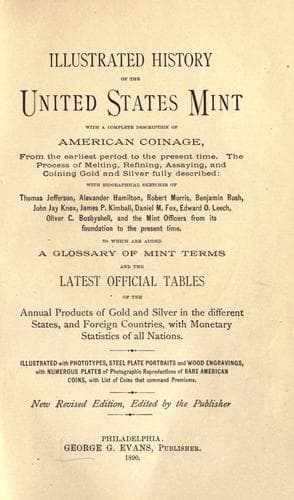
Illustrated history of the United States mint: with a complete description of American coinage, from the earliest period to the present time
History
Illustrated history of the United States mint: with a complete description of American coinage, from the earliest period to the present time
Coinage -- United States; Mints -- United States
1793. Same type as cent No. 4, 1793, with head facing left. On the edge,
“TWO HUNDRED FOR A DOLLAR.” Size, 14.
1794. Same type as the cent of 1794.
1795 to 1797, inclusive. Same, with plain edge.
1798 and 1799. None issued.
1800. Same type as No. 2 cent of 1796, with the fraction “⅟₂₀₀” on the
base of the reverse.
1801. None issued.
1802 to 1808, inclusive. Same as 1800. From 1808, the fraction “⅟₂₀₀”
omitted.
1809 to 1811, inclusive. Same type as cent of 1808.
1812 to 1824, inclusive. None issued.
1825 and 1826. Same type as cent of 1808.
1827. None issued.
1828. No. 1. Same type as cent 1808, with thirteen stars. No. 2. Same,
with twelve stars.
1829. Same, with thirteen stars.
1830. None issued.
1831 to 1836, inclusive. Same type as cent of 1808.
1837 to 1839, inclusive. None issued.
1840 to 1857, inclusive. Same type as No. 2 cent of 1837; size, 14.
THOMAS JEFFERSON,
an eminent American Statesman, and third President of the United States,
was born April 2, 1743, at Shadwell, Virginia, near the spot which
afterwards became his residence, with the name of Monticello. He was the
oldest son in a family of eight children. His father, Peter Jefferson,
was a man of great force of character and of extraordinary physical
strength. His mother, Jane Randolph, of Goochland, was descended from
an English family of great note and respectability. Young Jefferson
began his classical studies at the age of nine, and at seventeen he
entered an advance class at William and Mary College; on his way thither,
he formed the acquaintance of Patrick Henry, who was then a bankrupt
merchant, but who afterwards became the great orator of the Revolution.
At college, Jefferson was distinguished by his close application, and
devoted, it is said, from twelve to fifteen hours per day to study, and
we are told became well versed in Latin, Greek, Italian, French, and
Spanish, at the same time proficient in his mathematical studies. After
a few years course of law under Judge Wythe, he was admitted to the bar
in 1767. His success in the legal profession was remarkable; his fees
during the first year amounted to nearly three thousand dollars. In
1769, Jefferson commenced his public career as a member of the Virginia
House of Burgesses, in which he had while a student of law, listened to
Patrick Henry’s great speech on the Stamp Act. In 1773 he united with
Patrick Henry and other revolutionary patriots in devising the celebrated
committee of correspondence for disseminating intelligence between the
Colonies, of which Jefferson was one of the most active and influential
members. He was elected in 1774 to a convention to choose delegates to
the first Continental Congress at Philadelphia, and introduced at that
convention his famous “Summary view of the rights of British America.”
On the 21st of June, 1775, Jefferson took his seat in the Continental
Congress. His reputation as a Statesman and accomplished writer at once
Public-domain text, read in full here on John Shaqi.
Reviews
Reviews
No reviews yet
Be the first to share your thoughts on this work.
Elsewhere in the archive
Join the Discussion
Join the discussion
Sign in to leave a comment or review.
Sign InorCreate an account