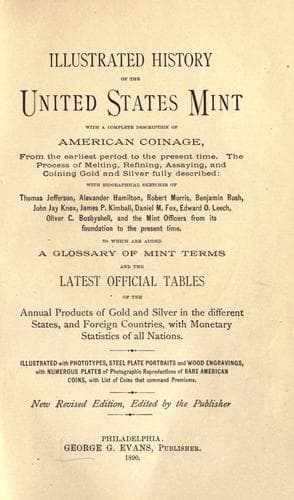
Illustrated history of the United States mint: with a complete description of American coinage, from the earliest period to the present time
History
Illustrated history of the United States mint: with a complete description of American coinage, from the earliest period to the present time
Coinage -- United States; Mints -- United States
placed him among the leaders of that renowned body. He served on the
most important committees, and among other papers drew up the reply of
Congress to the proposal of Lord North, and assisted in preparing in
behalf of the Colonies, a declaration of the cause of taking up arms
against the Mother Country. The rejection of a final petition to King
George, destroyed all hope of an honorable reconciliation with England.
Congress, early in 1776, appointed a committee to draw up a Declaration
of Independence, of which Jefferson was made Chairman; in this capacity
he drafted, at the request of the other members of the committee,
(Franklin, Adams, Sherman, and Livingston), and reported to Congress,
June 28, the great Charter of Freedom, known as the “Declaration of
American Independence,” which, on July 4, was unanimously adopted, and
signed by every member present, with a single exception. “The Declaration
of Independence,” says Edward Everett, “is equal to anything ever borne
on parchment, or expressed in the visible signs of thought.” “The heart
of Jefferson in writing it,” adds Bancroft, “and of Congress in adopting
it, _beat for all humanity_.” After resigning his seat in Congress,
Jefferson revised the laws of Virginia; among other reforms, he procured
the repeal of the laws of entail, the abolition of primogeniture, and
the restoration of the rights of conscience, a reform which he believed
would abolish “every fibre of ancient or future aristocracy;” he also
originated a complete system of elementary and collegiate education
for Virginia. In 1779, Jefferson succeeded Patrick Henry as Governor
of Virginia, and held the office during the most gloomy period of the
Revolution, and declined a re-election in 1781. In 1783, he returned to
Congress, and reported the treaty of peace, concluded at Paris, September
3, 1783, acknowledging the independence of the United States. He also
proposed and carried through Congress a bill establishing the present
Federal system of coinage, which took the place of the English pounds,
shillings, pence, etc., and also introduced measures for establishing a
Mint in Philadelphia, (the first public building built by the general
Government, still standing on Seventh street, east side, near Filbert).
In 1785, he succeeded Dr. Franklin as resident Minister at Paris. In
organizing the Government after the adoption of the Constitution, he
accepted the position of Secretary of State, tendered him by President
Washington during his first term. Jefferson was Vice-President of the
United States from 1797 to 1801, and President for the two consecutive
terms following. After participating in the inauguration of his friend
and successor, James Madison, Jefferson returned to Monticello, where
he passed the remainder of his life in directing the educational and
industrial institutions of his native State and entertaining his many
visitors and friends. His death occurred on the same day with that of
John Adams, July 4, 1826.
Public-domain text, read in full here on John Shaqi.
Reviews
Reviews
No reviews yet
Be the first to share your thoughts on this work.
Elsewhere in the archive
Join the Discussion
Join the discussion
Sign in to leave a comment or review.
Sign InorCreate an account