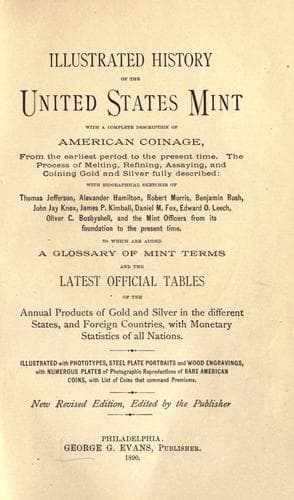
Illustrated history of the United States mint: with a complete description of American coinage, from the earliest period to the present time
History
Illustrated history of the United States mint: with a complete description of American coinage, from the earliest period to the present time
Coinage -- United States; Mints -- United States
Dr. Kimball has been largely identified with the mineral development
of Bedford County, Pa., and at the time of his appointment as Director
of the Mints, was President of the Everett Iron Company, whose blast
furnace, built in 1883-84, is one of the largest and finest in this
country. As a scientist he is a contributor to various scientific
journals at home and abroad, and among others the _American Journal of
Science_, published at New Haven. Several of his papers have appeared
in the proceedings of the American Institute of Mining Engineers, of
which he has been Vice President. Dr. Kimball has traveled extensively
in the United States, Mexico, and the West Indies, in prosecuting his
professional practice, and as a man of scientific accomplishments and of
affairs, bears a deservedly high reputation.
Dr. Kimball comes of Revolutionary stock. His paternal great-grandfather,
William Russell, of Boston, was associated with the Sons of Liberty, and
the leaders in public affairs in the times that tried men’s souls. He was
present, disguised as an Indian, and assisted in the famous Tea Party in
Boston harbor on the memorable 16th of December, 1773. Later, Mr. Russell
was adjutant of the Massachusetts Artillery, raised for the defense of
Boston, and which served in the Rhode Island campaign of 1777-78. Still
later, while serving as Secretary to Commander John Manley, of the U. S.
war vessel Jason, Russell was captured by the British frigate Surprise,
and confined in Mill prison till June 24, 1782, when he was exchanged.
But so sturdy a patriot could not rest unemployed, and twenty days after
his liberation, found him again in the naval service. He was again made
prisoner by the British, in November following, and consigned to the
notorious British prison ship, Jersey, lying off New York.
An anecdote is related by Mr. James Kimball, father of the subject of
this sketch, in a memoir on the Tea Party in Boston harbor furnished
the Essex Institute Historical collections (1874), which illustrates
the temper of Mr. Russell as a patriot. Returning to his home after the
destruction of the tea, he took off his shoes, and carefully dusted them
over the fire; he then took the tea canister and emptied its contents.
Next morning he had printed on one side of the canister, “Coffee,” and on
the other, “No Tea.” This was the brief decree of banishment promulgated
by the Tea Destroyers, and the prohibited luxury disappeared from their
tables.
HON. JOHN JAY KNOX.
Late Comptroller of the Currency, now President of the National Bank of
the Republic, New York City, we are indebted to _The Financier, August,
1885_, for the following biographical sketch:
Public-domain text, read in full here on John Shaqi.
Reviews
Reviews
No reviews yet
Be the first to share your thoughts on this work.
Elsewhere in the archive
Join the Discussion
Join the discussion
Sign in to leave a comment or review.
Sign InorCreate an account