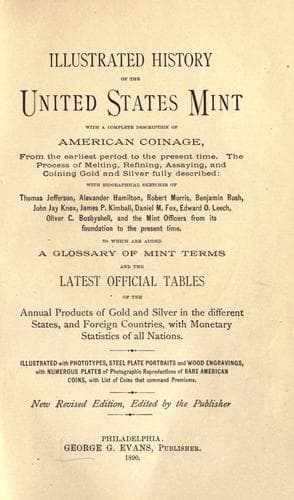
Illustrated history of the United States mint: with a complete description of American coinage, from the earliest period to the present time
History
Illustrated history of the United States mint: with a complete description of American coinage, from the earliest period to the present time
Coinage -- United States; Mints -- United States
was born in Salem, Mass., April 26, 1836. After graduating at the High
School of his native town in 1854, he entered the Lawrence Scientific
School of Harvard University. In the summer of the following year he went
to Germany, and matriculated at the University of Frederick Wilhelm,
Berlin, in the Fall of the same year, and was graduated at the University
of George Augusta, at Gottingen, in the Autumn of 1857, with the degrees
of Master of Arts and Doctor of Philosophy. Upon his graduation he
entered upon a practical course in Mining and Metallurgy, at the Mining
School of Freiburg, in Saxony.
After making a tour of the Continent and England, he returned home
and engaged as the Assistant of Prof. J. D. Whitney, now of Harvard
University, in the State Geological Surveys of the States of Wisconsin
and Illinois, embracing the Upper Mississippi lead region. He continued
with Prof. Whitney during the survey, comprising the southeastern part of
Iowa.
On the establishment of the New York State Agricultural College at Ovid,
the foundation of which was subsequently merged with that of Cornell
University, Dr. Kimball was appointed to the Chair of Professor of
Chemistry and Economic Geology. Upon the appointment of the President
of the college, Gen. Patrick, as Brigadier-General of Volunteers, Dr.
Kimball became that officer’s Chief of Staff, with a commission from
the President of the United States, as Assistant Adjutant-General of
Volunteers, with the rank of Captain. This was in 1862. His first
service in the field was with the Army of the Rappahannock, under Gen.
McDowell. He took part in numerous engagements, notably, those of
Groveton, Manassas, Chantilly, South Mountain, Antietam, Fredericksburg,
Chancellorsville, and Gettysburg. General Patrick having been assigned
to duty as Provost-Marshal of the Army of the Potomac, Capt. Kimball
accompanied him, and served on the General Staff of that army under
Generals McClellan, Burnside, Hooker, and Meade, successively.
When the army went into winter quarters, Capt. Kimball, whose health
had become impaired, resigned from the army, and settled in New York.
He resumed the practice of his profession as Mining Engineer and
Metallurgist. Upon his marriage, in 1874, he accepted an honorary
Professorship in Lehigh University, Bethlehem, Pa., removing from New
York to one of the houses in the beautiful park and grounds of that
institution, though retaining his office and business in New York City.
Public-domain text, read in full here on John Shaqi.
Reviews
Reviews
No reviews yet
Be the first to share your thoughts on this work.
Elsewhere in the archive
Join the Discussion
Join the discussion
Sign in to leave a comment or review.
Sign InorCreate an account