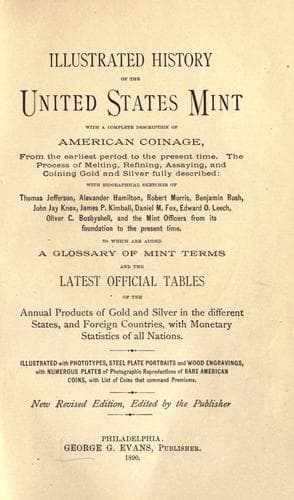
Illustrated history of the United States mint: with a complete description of American coinage, from the earliest period to the present time
History
Illustrated history of the United States mint: with a complete description of American coinage, from the earliest period to the present time
Coinage -- United States; Mints -- United States
The enactment of the Mint Law of 1873 marks an era in the Mint Service
of the United States. Prior to this, the Director of the Mint at
Philadelphia was the Director of all the Mints—the institution at
Philadelphia being regarded as the “Mother Mint,” and the others, at San
Francisco, New Orleans, etc., were called Branch Mints. Each branch had
its Superintendent, reporting direct to Philadelphia. But the authors of
the Act of 1873 regarded the Mint Service as so large and important a
part of the Government, that it should be constituted a separate Bureau
of the Treasury, with the Director located at Washington. One of the
promoters of this Act was the Hon. John Jay Knox, late Comptroller of
the Currency, and now President of the National Bank of the Republic,
New York. The following sketch of the origin and history of the new law
may prove of interest. It was originally published in Rhodes’ Journal of
Banking, July, 1884. Referring to Mr. Knox, the author says:
“In 1870 he made an elaborate report to Congress (Senate Mis.
Doc. No. 132, XLI. Cong., 2d Sess.), including a codification
of the Mint and Coinage laws, with important amendments, which
was highly commended. The method adopted in this codification
was, first, to arrange in as concise a form as possible the
coinage laws then in existence, with such additional sections
and suggestions as seemed valuable. The proposed bill was
then printed upon paper having a wide margin, and transmitted
to the officers of the different Mints and Assay offices,
and to such other gentlemen as were known to be conversant
and intelligent upon the subject of the coinage, with the
request that the printed bill should be returned with such
notes as experience and education should dictate. In this way
the views of many gentlemen who were conversant with these
subjects were obtained, with but little inconvenience to such
correspondents. This correspondence was subsequently published
by order of Congress, in H. R. Ex. Doc. No. 307, XLI. Cong.,
2d Sess. Having received these suggestions, the bill, which
comprised within the compass of eight or ten pages of the
Revised Statutes every important provision contained in more
than sixty different enactments upon the Mint and Coinage of
the United States—the result of eighty years of legislation—was
prepared and submitted to Congress. This bill, with but slight
amendments, was subsequently passed, and was known as ‘The
Coinage Act of 1873;’ and the Senate Finance Committee, in
recognition of the services of the Comptroller of the Currency,
by an amendment, made that officer an _ex-officio_ member of
the Assay Commission, which meets annually at the Mint in
Philadelphia for the purpose of testing the weight and fineness
of the coinage of the year. Upon his suggestion the coinage of
the silver dollar was discontinued, and the paragraph in the
Public-domain text, read in full here on John Shaqi.
Reviews
Reviews
No reviews yet
Be the first to share your thoughts on this work.
Elsewhere in the archive
Join the Discussion
Join the discussion
Sign in to leave a comment or review.
Sign InorCreate an account