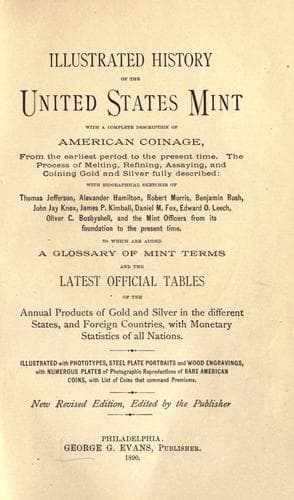
Illustrated history of the United States mint: with a complete description of American coinage, from the earliest period to the present time
History
Illustrated history of the United States mint: with a complete description of American coinage, from the earliest period to the present time
Coinage -- United States; Mints -- United States
report upon this subject was as follows:
“The coinage of the silver dollar-piece, the history of which
is here given, is discontinued in the proposed bill. It is by
law the dollar unit; and, assuming the value of gold to be
fifteen and one-half times that of silver, being about the
mean ratio for the past six years, is worth in gold a premium
of about three per cent., its value being $1.03.12, and
intrinsically more than seven per cent. premium in our other
silver coins, its value thus being $1.07.42. The present laws
consequently authorize both a gold dollar unit and a silver
dollar unit, differing from each other in intrinsic value.
The present gold dollar-piece is made the dollar unit in the
proposed bill, and the silver piece is discontinued.”
The first Director of the Mint under this new law, was the Hon. Henry R.
Linderman. The title of the chief officer at Philadelphia being changed
to Superintendent—the first incumbent with that title was the Hon. James
Pollock.
Biographical notices of these officers will be found in their appropriate
place in this volume.
DIRECTORS OF THE MINT.
DAVID RITTENHOUSE, FIRST DIRECTOR OF THE MINT.
Entering the Cabinet, the portraits of the different Directors attract
attention. That of David Rittenhouse is the copy of a painting by Charles
Willson Peale. Mr. Rittenhouse was appointed by Washington, April 14,
1792, and remained in charge of the Mint until June, 1795, when his
declining health compelled him to resign.
At an early age he indicated mechanical talent of a high order in the
construction of a clock, and his studies from that time were principally
mathematical. His genius soon attracted attention, and he was appointed
by the colonial governor a surveyor, and in that capacity determined the
famous Mason and Dixon line. He succeeded Benjamin Franklin as President
of the American Philosophical Society. Mr. Barber, late Engraver of the
Mint, executed a bronze medal of Dr. Rittenhouse. Possibly, excepting
Duvivier’s head of Washington after Houdon, it cannot be surpassed in
the Cabinet. The engraver had a very fine subject, and treated it in the
highest style of art. On the obverse is “David Rittenhouse,” with date of
birth and death. On the reverse, inscription, “He belonged to the whole
human race.”—“Wm. Barber.” This beautiful memento is highly prized.
HENRY WILLIAM DESAUSSURE, SECOND DIRECTOR OF THE MINT.
Public-domain text, read in full here on John Shaqi.
Reviews
Reviews
No reviews yet
Be the first to share your thoughts on this work.
Elsewhere in the archive
Join the Discussion
Join the discussion
Sign in to leave a comment or review.
Sign InorCreate an account