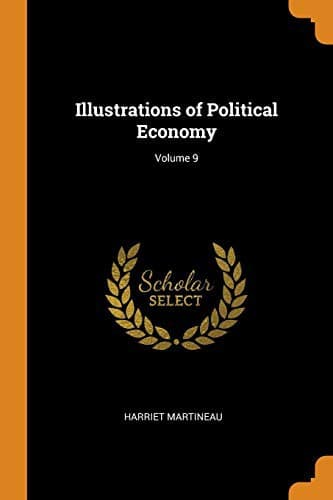
Illustrations of political economy, Volume 9 (of 9) — John Shaqi
Illustrations of political economy, Volume 9 (of 9)Martineau, Harriet
General
Illustrations of political economy, Volume 9 (of 9)
Martineau, Harriet
Didactic fiction, English; Political fiction, English; Social problems -- Fiction
“Well done, Harry! You will do very well soon, and make up for the
cheese you have crumbled to-day. You will manage not to spill so much
sugar to-morrow, perhaps. And by the end of the year, we shall see what
sort of a younger partner’s share we can afford you.”
“You do not mean that I am to spend a whole year as I have spent to-day,
father?”
“Indeed but I do, though; and as many more years as you have to live. My
father made his fortune in this same business, and I mean my sons to do
the same.”
Henry answered by handing his father the candle to light his pipe.
“I say, Harry,” the old man resumed, after a long silence, “you go into
the shop to-morrow morning.”
“Certainly; till Michael comes back; if, as you said this morning, he
returns before the end of the week.”
“And after he comes back. He will put you in the way better than I can,
you’ll find.”
“After he comes back, I hope to find means of using the education you
have given me, father. It would be all lost if I were to be a grocer.”
Mr. Farrer could see nothing but loss in following any other occupation,
and ingratitude in hesitating to accept a provision which would enable
Henry to become, like his brother and sisters, a public creditor on very
advantageous terms. He let his son more into the secret of his wealth
than he had ever done before; and when he found this confidence of no
avail to his purpose, was vexed at his communicativeness, grew very
angry, threw down his pipe, and ordered the family to bed.
The next day, and the next, all went on so smoothly in the shop that
each party hoped the other had relented. On the Friday evening, Michael
returned, in high spirits, his talk savouring of the sea as his clothes
did of tobacco. On Saturday morning, Henry was missing in his turn.
Morgan appeared with red eyes to say that he had gone out with his blue
bag very early, and had left the letter she now delivered to her master.
This letter was read, crumpled up and thrown under the grate in silence.
Jane afterwards took possession of it; and found that Henry valued his
education too highly not to make the best use he could of it; that he
was quite of his father’s opinion that it was a sin to remain at home in
idleness; that he would therefore endeavour to obtain immediate
employment and independence; that he would come and see his father as
soon as he had anything to communicate, and should be always on the
watch to repay by any duty and attention in his power the obligation he
was under for the advantages he had enjoyed.
Morgan had no intelligence to give of where Henry was gone. He had left
his love for his sister, and an assurance that he would see her soon and
often. Morgan trusted she might take his word for his not feeling
himself “put upon” or ill-regarded in the family. He had assured her
that his feelings for them were as kind as ever, as he hoped to show, if
occasion should arise. Might she believe this?
Public-domain text, read in full here on John Shaqi.
Reviews
Reviews
No reviews yet
Be the first to share your thoughts on this work.
Join the Discussion
Join the discussion
Sign in to leave a comment or review.
Sign InorCreate an account