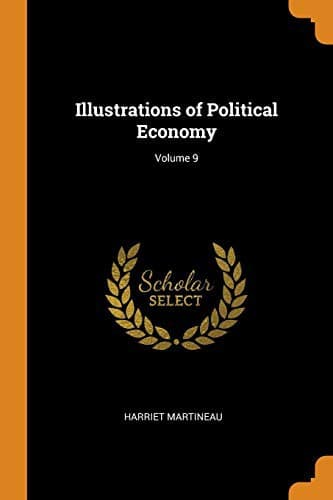
Illustrations of political economy, Volume 9 (of 9)Martineau, Harriet
General
Illustrations of political economy, Volume 9 (of 9)
Martineau, Harriet
Didactic fiction, English; Political fiction, English; Social problems -- Fiction
“That prevented many a patient of mine from being properly nursed,” said
Dr. Say. “When people are just so poor as not to afford much
candlelight, such a tax as that dooms many sick to toss about in the
dark, frightened at their own fancies, when a light, to show things as
they are, would have composed them to sleep. That was a bad tax: the
rich using few tallow candles.”
“If that be bad, the others were worse;—that on cottages with less than
seven windows! Lord! I shall never forget what work I used to have and
to hear of about that tax. He must have been a perverse genius that
thought of that tax, and deserved to be put into a cottage of two
windows himself.—Do you hear, Mr. Farrer, that is over and gone; and I
suppose you used to pay a tax upon Morgan that you are not asked for
now?”
Mr. Farrer now proved himself still able to laugh, while he told how he
never paid a farthing for Morgan before the tax on female servants had
been repealed. Morgan believed herself to be the fiftieth cousin of the
family; and on the days when the tax-gatherer was expected, Farrer
always contrived that Morgan should be seated at some employment found
for her in the parlour, and called a relation of the family. Jane now
understood for the first time why her father was upon occasion so
strangely peremptory about the sofa cover being patched, or his shirts
mended, by no one but Morgan, and nowhere but in the parlour. The repeal
of these three assessed taxes, and of a fourth,—on carts and waggons,—
was acknowledged to be an improvement on old management, however
grievous might be the actual burdens, and the great one now in prospect.
In pursuance of his plan to give Mr. Farrer none but pleasant ideas to
carry to the grave, Peek proceeded to observe on the capability of the
country to bear much heavier burdens than formerly. Arkwright alone had
provided the means of paying a large amount of taxes, by endowing the
country with the vast resources of the cotton manufacture.
“And what came of it all?” muttered Mr. Farrer. “There is Arkwright in
his grave, just like any other man.”
“That’s very true; and just as if he had had no more than his three
hundred a-year all his days. But it was a noble thing that he did,—the
enabling the country to bear up in such times as we live in. For my
part, I think the minister may very fairly ask for more money when such
a piece of good luck has befallen us as our cotton manufacture turns out
to be. I’m not so much against the war, since there is this way of
paying for it.”
“You forget we are in debt, Peek. ‘Duty first, and pleasure afterwards,’
I say. ‘Charity begins at home,’ say I. Pay the debt first, and then go
to war, if you must.”
“Some other improvements will turn up, time enough to pay the debt, I
dare say. When the war is done, the minister has only to find somebody,
like Arkwright, that will make a grand invention, and then he can pay
off the debt at his leisure.”
Public-domain text, read in full here on John Shaqi.
Reviews
Reviews
No reviews yet
Be the first to share your thoughts on this work.
Join the Discussion
Join the discussion
Sign in to leave a comment or review.
Sign InorCreate an account