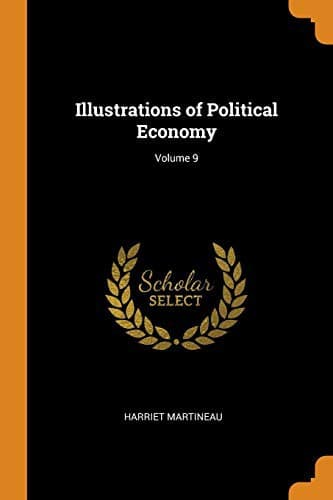
Illustrations of political economy, Volume 9 (of 9)Martineau, Harriet
General
Illustrations of political economy, Volume 9 (of 9)
Martineau, Harriet
Didactic fiction, English; Political fiction, English; Social problems -- Fiction
“Spain, if you will. But one need go no farther than Marie’s own unhappy
country. Would her king have been murdered,—would the people have
defiled their emancipation with atrocities, if they had not been sunk in
poverty, and steeped in injuries, by a devouring taxation? That taxation
might, I verily believe, have been borne, as to its amount; but that
amount was taken, not at all from the rich and noble, but wholly from
the industrious. The rich and noble spent their revenue as much as if
they had been duly taxed; while the industrious paid, first their
income, and then their capital, till the labourers, whose hire was thus
kept back from them, rose up against the rich, and scattered them to the
winds of heaven. The oppressors are removed; but there is no recovery of
the substance which they wasted. The impoverished may now come forth,
and raise their cry of famine before the face of heaven, but the food
that was taken from them there is none to restore.”
“So much for poor France!” said Henry, writing rapidly. “Now for Spain.”
“Take but one Spanish tax,—take but the Alcavala, and you have
sufficient reason why, with her prime soil, her wealth of metals, her
colonies whither to send her superfluous consumers, Spain is wretched in
her poverty. The alcavala (the monstrous per centage on all articles,
raw or manufactured, as often as they are sold) must encroach more and
more largely on the capital which is the material of wealth. Under the
alcavala, Spain could not but be ruined.”
“Except in those provinces where there was no alcavala—Catalonia and
Valencia. They bore up long after all others had sunk. There, Marie!
There are your three examples. We have no room for the many more that
rise up.”
“Not for England?”
“England! You do not think England on the road to ruin, my dear? You do
not yet understand England’s resources.”
“Perhaps not. But you told me of eight hundred bankruptcies within the
last seven months. Have you no practice of taxing your capital?”
“We have a few taxes,—bad taxes,—which are paid out of capital,—as my
sister Jane will tell you. She knows something now of how legacies are
reduced by the duties government demands. It is a bad practice to lessen
property in the act of transference. Such taxes consume capital, and
obstruct its circulation. But we have not many such. In one sense or
another, to be sure, every tax may be proved to come out of capital,
more or less; but almost all ours are paid out of our revenue: and so
will be almost any that can be proposed, provided the amount be not
increased. With the revenue that England has, and the ambition that her
people entertain not to sink in society, exertion will be made to keep
her capital entire, as long as there is any reasonable hope of success.
We shall invent, and improve, and save, to a vast extent, before we let
our capital be sacrificed.”
“In the case of your property tax?”
Public-domain text, read in full here on John Shaqi.
Reviews
Reviews
No reviews yet
Be the first to share your thoughts on this work.
Join the Discussion
Join the discussion
Sign in to leave a comment or review.
Sign InorCreate an account