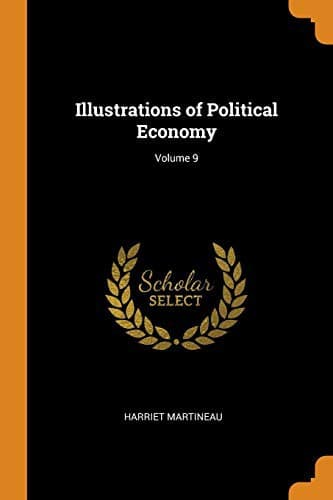
Illustrations of political economy, Volume 9 (of 9) — John Shaqi
Illustrations of political economy, Volume 9 (of 9)Martineau, Harriet
General
Illustrations of political economy, Volume 9 (of 9)
Martineau, Harriet
Didactic fiction, English; Political fiction, English; Social problems -- Fiction
Marie went to her cupboard, and brought out the little powdered sugar
that remained at the bottom of the last parcel she had bought. She had
tasted no sugar for some time; and it was by very nice management that
she had been able to procure any for her father. She hoped that what had
been written this week might supply comforts for the next. Meantime,
Jane’s entrance had baffled her calculations about the sugar. Henry
smiled at the disclosure, and helped himself to another cup of coffee,
without sugar. Marie would have borrowed from the woman of the house;
but her father would not allow it. His daughter rightly imagined that he
felt uncertain of being able to pay a debt of a mere luxury, and
therefore did not choose to incur it.
“Ah, well!” said she; “everything will cost us less money, let us hope,
when men have left off fighting like dogs, that they may render
peaceable men beggars. They make us pay for their wars out of our tea
and our sugar,—and out of our heart’s blood, papa, when they make us
deny our parents what they expect at our hands.”
M. Verblanc wished that Marie could have, during this time of war, the
sugar that was now growing in her beloved garden at home. Beet-root was
now largely used for making sugar in France; and M. Verblanc had learned
that the produce of his estates was considerable. These estates had been
bought in by a friend; and it was hoped that they would in time be
restored to the rightful owner.
Marie’s scorn was excited by the idea of beet-root growing where her
parterres had looked gay, and where the urns, and statues, and small
fountains, originated by her taste, could have little congeniality with
so thoroughly common and useful a produce as beet-root. She mentioned
one field, and another, and another, which would answer the purpose
quite as well as her garden. As she lightly mapped out the places she
mentioned, Jane’s eye followed her pencil as eagerly as Henry’s. She
asked of M. Verblanc, at length, whether the tenure of land was yet
considered secure in France.
“Of some lands, yes,” answered he. “If, for example, you will buy our
estates, and grow beet-root, no one will turn you out; and it will give
us true satisfaction to see our lands pass into such honourable hands.”
To Henry’s surprise, his sister seemed meditative. Marie looked up,
smiling. “Will you buy our lands?”
“She cannot,” said Henry. “The law is against investing capital in an
enemy’s country.”
“Is it?” said Jane, quickly.
“One would suppose you were really thinking of it, Jane. If you want to
try your hand at farming, there is abundance of land in England.”
Jane muttered that in England there would also be an income tax
immediately.
“And what of that? If you invested your money abroad, you would not go
and live there, would you?”
Public-domain text, read in full here on John Shaqi.
Reviews
Reviews
No reviews yet
Be the first to share your thoughts on this work.
Join the Discussion
Join the discussion
Sign in to leave a comment or review.
Sign InorCreate an account