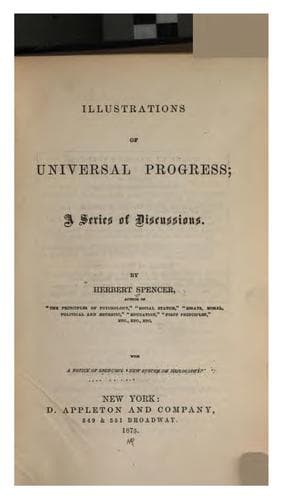
Illustrations of Universal Progress: A Series of DiscussionsSpencer, Herbert
Philosophy
Illustrations of Universal Progress: A Series of Discussions
Spencer, Herbert
Philosophy; Political science; Science
And then note, lastly, that in this case, as in all others, when an
organization has become effete and inoperative for its legitimate purpose,
it is employed for quite other ones--quite opposite ones. What is the usual
plea put in for giving and attending these tedious assemblies? "I admit
that they are stupid and frivolous enough," replies every man to your
criticisms; "but then, you know, one must keep up one's connections." And
could you get from his wife a sincere answer, it would be--"Like you, I am
sick of these frivolities; but then, we must get our daughters married."
The one knows that there is a profession to push, a practice to gain, a
business to extend: or parliamentary influence, or county patronage, or
votes, or office, to be got: position, berths, favours, profit. The other's
thoughts runs upon husbands and settlements, wives and dowries. Worthless
for their ostensible purpose of daily bringing human beings into
pleasurable relations with each other, these cumbrous appliances of our
social intercourse are now perseveringly kept in action with a view to the
pecuniary and matrimonial results which they indirectly produce.
Who then shall say that the reform of our system of observances is
unimportant? When we see how this system induces fashionable extravagance,
with its entailed bankruptcy and ruin--when we mark how greatly it limits
the amount of social intercourse among the less wealthy classes--when we
find that many who most need to be disciplined by mixing with the refined
are driven away by it, and led into dangerous and often fatal courses--when
we count up the many minor evils it inflicts, the extra work which its
costliness entails on all professional and mercantile men, the damage to
public taste in dress and decoration by the setting up of its absurdities
as standards for imitation, the injury to health indicated in the faces of
its devotees at the close of the London season, the mortality of milliners
and the like, which its sudden exigencies yearly involve;--and when to all
these we add its fatal sin; that it blights, withers up, and kills, that
high enjoyment it professedly ministers to--that enjoyment which is a chief
end of our hard struggling in life to obtain--shall we not conclude that to
reform our system of etiquette and fashion, is an aim yielding to few in
urgency?
* * * * *
Public-domain text, read in full here on John Shaqi.
Reviews
Reviews
No reviews yet
Be the first to share your thoughts on this work.
Elsewhere in the archive
Join the Discussion
Join the discussion
Sign in to leave a comment or review.
Sign InorCreate an account