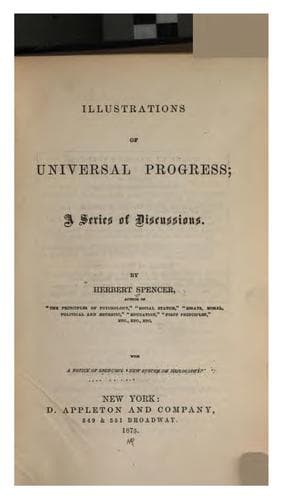
Illustrations of Universal Progress: A Series of DiscussionsSpencer, Herbert
Philosophy
Illustrations of Universal Progress: A Series of Discussions
Spencer, Herbert
Philosophy; Political science; Science
There needs, then, a protestantism in social usages. Forms that have ceased
to facilitate and have become obstructive--whether political, religious, or
other--have ever to be swept away; and eventually are so swept away in all
cases. Signs are not wanting that some change is at hand. A host of
satirists, led on by Thackeray, have been for years engaged in bringing our
sham-festivities, and our fashionable follies, into contempt; and in their
candid moods, most men laugh at the frivolities with which they and the
world in general are deluded. Ridicule has always been a revolutionary
agent. That which is habitually assailed with sneers and sarcasms cannot
long survive. Institutions that have lost their roots in men's respect and
faith are doomed; and the day of their dissolution is not far off. The time
is approaching, then, when our system of social observances must pass
through some crisis, out of which it will come purified and comparatively
simple.
How this crisis will be brought about, no one can with any certainty say.
Whether by the continuance and increase of individual protests, or whether
by the union of many persons for the practice and propagation of some
better system, the future alone can decide. The influence of dissentients
acting without co-operation, seems, under the present state of things,
inadequate. Standing severally alone, and having no well-defined views;
frowned on by conformists, and expostulated with even by those who secretly
sympathize with them; subject to petty persecutions, and unable to trace
any benefit produced by their example; they are apt, one by one, to give up
their attempts as hopeless. The young convention-breaker eventually finds
that he pays too heavily for his nonconformity. Hating, for example,
everything that bears about it any remnant of servility, he determines, in
the ardour of his independence, that he will uncover to no one. But what he
means simply as a general protest, he finds that ladies interpret into a
personal disrespect. Though he sees that, from the days of chivalry
downwards, these marks of supreme consideration paid to the other sex have
been but a hypocritical counterpart to the actual subjection in which men
have held them--a pretended submission to compensate for a real domination;
and though he sees that when the true dignity of women is recognised, the
mock dignities given to them will be abolished; yet he does not like to be
thus misunderstood, and so hesitates in his practice.
Public-domain text, read in full here on John Shaqi.
Reviews
Reviews
No reviews yet
Be the first to share your thoughts on this work.
Elsewhere in the archive
Join the Discussion
Join the discussion
Sign in to leave a comment or review.
Sign InorCreate an account