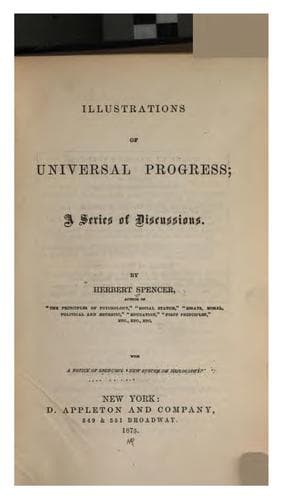
Illustrations of Universal Progress: A Series of DiscussionsSpencer, Herbert
Philosophy
Illustrations of Universal Progress: A Series of Discussions
Spencer, Herbert
Philosophy; Political science; Science
Society, in all its developments, undergoes the process of exuviation.
These old forms which it successively throws off, have all been once
vitally united with it--have severally served as the protective envelopes
within which a higher humanity was being evolved. They are cast aside only
when they become hindrances--only when some inner and better envelope has
been formed; and they bequeath to us all that there was in them good. The
periodical abolitions of tyrannical laws have left the administration of
justice not only uninjured, but purified. Dead and buried creeds have not
carried with them the essential morality they contained, which still
exists, uncontaminated by the sloughs of superstition. And all that there
is of justice and kindness and beauty, embodied in our cumbrous forms of
etiquette, will live perennially when the forms themselves have been
forgotten.
III. THE GENESIS OF SCIENCE.
There has ever prevailed among men a vague notion that scientific knowledge
differs in nature from ordinary knowledge. By the Greeks, with whom
Mathematics--literally _things learnt_--was alone considered as knowledge
proper, the distinction must have been strongly felt; and it has ever since
maintained itself in the general mind. Though, considering the contrast
between the achievements of science and those of daily unmethodic thinking,
it is not surprising that such a distinction has been assumed; yet it needs
but to rise a little above the common point of view, to see that no such
distinction can really exist: or that at best, it is but a superficial
distinction. The same faculties are employed in both cases; and in both
cases their mode of operation is fundamentally the same.
If we say that science is organized knowledge, we are met by the truth that
all knowledge is organized in a greater or less degree--that the commonest
actions of the household and the field presuppose facts colligated,
inferences drawn, results expected; and that the general success of these
actions proves the data by which they were guided to have been correctly
put together. If, again, we say that science is prevision--is a seeing
beforehand--is a knowing in what times, places, combinations, or sequences,
specified phenomena will be found; we are yet obliged to confess that the
definition includes much that is utterly foreign to science in its ordinary
acceptation. For example, a child's knowledge of an apple. This, as far as
it goes consists in previsions. When a child sees a certain form and
colours, it knows that if it puts out its hand it will have certain
impressions of resistance, and roundness, and smoothness; and if it bites,
a certain taste. And manifestly its general acquaintance with surrounding
objects is of like nature--is made up of facts concerning them, so grouped
as that any part of a group being perceived, the existence of the other
facts included in it is foreseen.
Public-domain text, read in full here on John Shaqi.
Reviews
Reviews
No reviews yet
Be the first to share your thoughts on this work.
Elsewhere in the archive
Join the Discussion
Join the discussion
Sign in to leave a comment or review.
Sign InorCreate an account