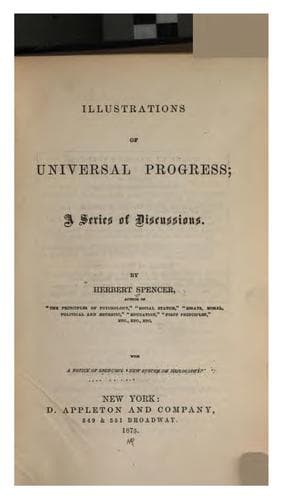
Illustrations of Universal Progress: A Series of DiscussionsSpencer, Herbert
Philosophy
Illustrations of Universal Progress: A Series of Discussions
Spencer, Herbert
Philosophy; Political science; Science
If, once more, we say that science is _exact_ prevision, we still fail to
establish the supposed difference. Not only do we find that much of what we
call science is not exact, and that some of it, as physiology, can never
become exact; but we find further, that many of the previsions constituting
the common stock alike of wise and ignorant, _are_ exact. That an
unsupported body will fall; that a lighted candle will go out when immersed
in water; that ice will melt when thrown on the fire--these, and many like
predictions relating to the familiar properties of things have as high a
degree of accuracy as predictions are capable of. It is true that the
results predicated are of a very general character; but it is none the less
true that they are rigorously correct as far as they go: and this is all
that is requisite to fulfil the definition. There is perfect accordance
between the anticipated phenomena and the actual ones; and no more than
this can be said of the highest achievements of the sciences specially
characterised as exact.
Seeing thus that the assumed distinction between scientific knowledge and
common knowledge is not logically justifiable; and yet feeling, as we must,
that however impossible it may be to draw a line between them, the two are
not practically identical; there arises the question--What is the
relationship that exists between them? A partial answer to this question
may be drawn from the illustrations just given. On reconsidering them, it
will be observed that those portions of ordinary knowledge which are
identical in character with scientific knowledge, comprehend only such
combinations of phenomena as are directly cognizable by the senses, and are
of simple, invariable nature. That the smoke from a fire which she is
lighting will ascend, and that the fire will presently boil water, are
previsions which the servant-girl makes equally well with the most learned
physicist; they are equally certain, equally exact with his; but they are
previsions concerning phenomena in constant and direct relation--phenomena
that follow visibly and immediately after their antecedents--phenomena of
which the causation is neither remote nor obscure--phenomena which may be
predicted by the simplest possible act of reasoning.
Public-domain text, read in full here on John Shaqi.
Reviews
Reviews
No reviews yet
Be the first to share your thoughts on this work.
Elsewhere in the archive
Join the Discussion
Join the discussion
Sign in to leave a comment or review.
Sign InorCreate an account