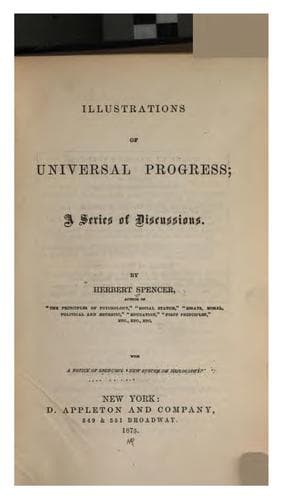
Illustrations of Universal Progress: A Series of DiscussionsSpencer, Herbert
Philosophy
Illustrations of Universal Progress: A Series of Discussions
Spencer, Herbert
Philosophy; Political science; Science
"There appears to have got abroad in the United States, a very
erroneous impression respecting the influence of Comte's writings in
England. I suppose that the currency obtained by the words 'Positivism'
and 'Positivist,' is to blame for this. Comte having designated by the
term Positive Philosophy all that body of definitely-established
knowledge which men of science have been gradually organizing into a
coherent body of doctrine, and having habitually placed this in
opposition to the incoherent body of doctrine defended by theologians,
it has become the habit of the theological party to think of the
antagonist scientific party under this title of Positivists applied to
them by Comte. And thus, from the habit of calling them Positivists
there has grown up the assumption that they call themselves
Positivists, and that they are the disciples of Comte. The truth is
that Comte and his doctrines receive here scarcely any attention. I
know something of the scientific world in England, and I cannot name a
single man of science who acknowledges himself a follower of Comte, or
accepts the title of Positivist. Lest, however, there should be some
such who were unknown to me, I have recently made inquiries into the
matter. To Professor Tyndall I put the question whether Comte had
exerted any appreciable influence on his own course of thought: and he
replied, 'So far as I know, my own course of thought would have been
exactly the same had Comte never existed.' I then asked, 'Do you know
any men of science whose views have been affected by Comte's writings?'
and his answer was: 'His influence on scientific thought in England is
absolutely _nil_.' To the same questions Prof. Huxley returned, in
other words, the same answers. Professors Huxley and Tyndall, being
leaders in their respective departments, and being also men of general
culture and philosophic insight, I think that, joining their
impressions with my own, I am justified in saying that the scientific
world of England is wholly uninfluenced by Comte. Such small influence
as he has had here has been on some literary men and historians--men
who were attracted by the grand achievements of science, who were
charmed by the plausible system of scientific generalizations put forth
by Comte, with the usual French regard for symmetry and disregard for
fact, and who were, from their want of scientific training, unable to
detect the essential fallaciousness of his system. Of these the most
notable example was the late Mr. Buckle. Besides him, I can name but
seven men who have been in any appreciable degree influenced by Comte;
and of these, four, if not five, are scarcely known to the public."
Public-domain text, read in full here on John Shaqi.
Reviews
Reviews
No reviews yet
Be the first to share your thoughts on this work.
Join the Discussion
Join the discussion
Sign in to leave a comment or review.
Sign InorCreate an account