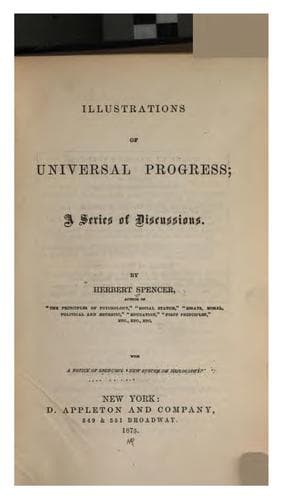
Illustrations of Universal Progress: A Series of DiscussionsSpencer, Herbert
Philosophy
Illustrations of Universal Progress: A Series of Discussions
Spencer, Herbert
Philosophy; Political science; Science
On further considering the matter, however, it will perhaps be felt that
this definition does not express the whole fact--that inseparable as
science may be from common knowledge, and completely as we may fill up the
gap between the simplest previsions of the child and the most recondite
ones of the natural philosopher, by interposing a series of previsions in
which the complexity of reasoning involved is greater and greater, there is
yet a difference between the two beyond that which is here described. And
this is true. But the difference is still not such as enables us to draw
the assumed line of demarcation. It is a difference not between common
knowledge and scientific knowledge; but between the successive phases of
science itself, or knowledge itself--whichever we choose to call it. In its
earlier phases science attains only to _certainty_ of foreknowledge; in its
later phases it further attains to _completeness_. We begin by discovering
_a_ relation: we end by discovering _the_ relation. Our first achievement
is to foretell the _kind_ of phenomenon which will occur under specific
conditions: our last achievement is to foretell not only the kind but the
_amount_. Or, to reduce the proposition to its most definite
form--undeveloped science is _qualitative_ prevision: developed science is
_quantitative_ prevision.
This will at once be perceived to express the remaining distinction between
the lower and the higher stages of positive knowledge. The prediction that
a piece of lead will take more force to lift it than a piece of wood of
equal size, exhibits certainty, but not completeness, of foresight. The
kind of effect in which the one body will exceed the other is foreseen; but
not the amount by which it will exceed. There is qualitative prevision
only. On the other hand, the prediction that at a stated time two
particular planets will be in conjunction; that by means of a lever having
arms in a given ratio, a known force will raise just so many pounds; that
to decompose a specified quantity of sulphate of iron by carbonate of soda
will require so many grains--these predictions exhibit foreknowledge, not
only of the nature of the effects to be produced, but of the magnitude,
either of the effects themselves, of the agencies producing them, or of the
distance in time or space at which they will be produced. There is not only
qualitative but quantitative prevision.
Public-domain text, read in full here on John Shaqi.
Reviews
Reviews
No reviews yet
Be the first to share your thoughts on this work.
Elsewhere in the archive
Join the Discussion
Join the discussion
Sign in to leave a comment or review.
Sign InorCreate an account