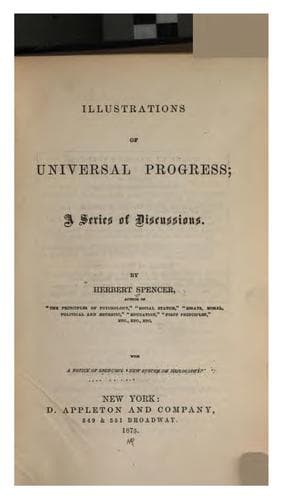
Illustrations of Universal Progress: A Series of DiscussionsSpencer, Herbert
Philosophy
Illustrations of Universal Progress: A Series of Discussions
Spencer, Herbert
Philosophy; Political science; Science
And this is the unexpressed difference which leads us to consider certain
orders of knowledge as especially scientific when contrasted with knowledge
in general. Are the phenomena _measurable_? is the test which we
unconsciously employ. Space is measurable: hence Geometry. Force and space
are measurable: hence Statics. Time, force, and space are measurable: hence
Dynamics. The invention of the barometer enabled men to extend the
principles of mechanics to the atmosphere; and Aerostatics existed. When a
thermometer was devised there arose a science of heat, which was before
impossible. Such of our sensations as we have not yet found modes of
measuring do not originate sciences. We have no science of smells; nor have
we one of tastes. We have a science of the relations of sounds differing in
pitch, because we have discovered a way to measure them; but we have no
science of sounds in respect to their loudness or their _timbre_, because
we have got no measures of loudness and _timbre_.
Obviously it is this reduction of the sensible phenomena it represents, to
relations of magnitude, which gives to any division of knowledge its
especially scientific character. Originally men's knowledge of weights and
forces was in the same condition as their knowledge of smells and tastes is
now--a knowledge not extending beyond that given by the unaided sensations;
and it remained so until weighing instruments and dynamometers were
invented. Before there were hour-glasses and clepsydras, most phenomena
could be estimated as to their durations and intervals, with no greater
precision than degrees of hardness can be estimated by the fingers. Until a
thermometric scale was contrived, men's judgments respecting relative
amounts of heat stood on the same footing with their present judgments
respecting relative amounts of sound. And as in these initial stages, with
no aids to observation, only the roughest comparisons of cases could be
made, and only the most marked differences perceived; it is obvious that
only the most simple laws of dependence could be ascertained--only those
laws which being uncomplicated with others, and not disturbed in their
manifestations, required no niceties of observation to disentangle them.
Whence it appears not only that in proportion as knowledge becomes
quantitative do its previsions become complete as well as certain, but that
until its assumption of a quantitative character it is necessarily confined
to the most elementary relations.
Public-domain text, read in full here on John Shaqi.
Reviews
Reviews
No reviews yet
Be the first to share your thoughts on this work.
Elsewhere in the archive
Join the Discussion
Join the discussion
Sign in to leave a comment or review.
Sign InorCreate an account