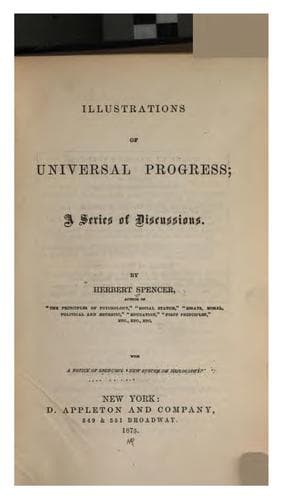
Illustrations of Universal Progress: A Series of DiscussionsSpencer, Herbert
Philosophy
Illustrations of Universal Progress: A Series of Discussions
Spencer, Herbert
Philosophy; Political science; Science
Moreover, it must be borne in mind not only that all the sciences are
qualitative in their first stages,--not only that some of them, as
Chemistry, have but recently reached the quantitative stage--but that the
most advanced sciences have attained to their present power of determining
quantities not present to the senses, or not directly measurable, by a slow
process of improvement extending through thousands of years. So that
science and the knowledge of the uncultured are alike in the nature of
their previsions, widely as they differ in range; they possess a common
imperfection, though this is immensely greater in the last than in the
first; and the transition from the one to the other has been through a
series of steps by which the imperfection has been rendered continually
less, and the range continually wider.
These facts, that science and the positive knowledge of the uncultured
cannot be separated in nature, and that the one is but a perfected and
extended form of the other, must necessarily underlie the whole theory of
science, its progress, and the relations of its parts to each other. There
must be serious incompleteness in any history of the sciences, which,
leaving out of view the first steps of their genesis, commences with them
only when they assume definite forms. There must be grave defects, if not a
general untruth, in a philosophy of the sciences considered in their
interdependence and development, which neglects the inquiry how they came
to be distinct sciences, and how they were severally evolved out of the
chaos of primitive ideas.
Not only a direct consideration of the matter, but all analogy, goes to
show that in the earlier and simpler stages must be sought the key to all
subsequent intricacies. The time was when the anatomy and physiology of the
human being were studied by themselves--when the adult man was analyzed and
the relations of parts and of functions investigated, without reference
either to the relations exhibited in the embryo or to the homologous
relations existing in other creatures. Now, however, it has become manifest
that no true conceptions, no true generalizations, are possible under such
conditions. Anatomists and physiologists now find that the real natures of
organs and tissues can be ascertained only by tracing their early
evolution; and that the affinities between existing genera can be
satisfactorily made out only by examining the fossil genera to which they
are allied. Well, is it not clear that the like must be true concerning all
things that undergo development? Is not science a growth? Has not science,
too, its embryology? And must not the neglect of its embryology lead to a
misunderstanding of the principles of its evolution and of its existing
organization?
Public-domain text, read in full here on John Shaqi.
Reviews
Reviews
No reviews yet
Be the first to share your thoughts on this work.
Elsewhere in the archive
Join the Discussion
Join the discussion
Sign in to leave a comment or review.
Sign InorCreate an account