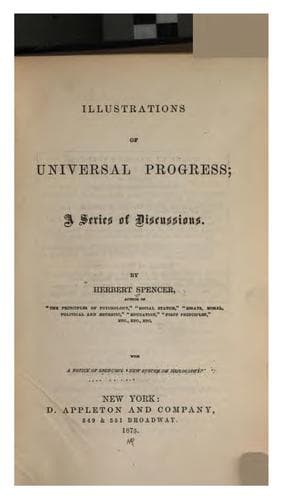
Illustrations of Universal Progress: A Series of DiscussionsSpencer, Herbert
Philosophy
Illustrations of Universal Progress: A Series of Discussions
Spencer, Herbert
Philosophy; Political science; Science
Moreover it is to be remarked that while, on the one hand, we can discover
the laws of the greater proportion of phenomena only by investigating them
quantitatively; on the other hand we can extend the range of our
quantitative previsions only as fast as we detect the laws of the results
we predict. For clearly the ability to specify the magnitude of a result
inaccessible to direct measurement, implies knowledge of its mode of
dependence on something which can be measured--implies that we know the
particular fact dealt with to be an instance of some more general fact.
Thus the extent to which our quantitative previsions have been carried in
any direction, indicates the depth to which our knowledge reaches in that
direction. And here, as another aspect of the same fact, we may further
observe that as we pass from qualitative to quantitative prevision, we pass
from inductive science to deductive science. Science while purely inductive
is purely qualitative: when inaccurately quantitative it usually consists
of part induction, part deduction: and it becomes accurately quantitative
only when wholly deductive. We do not mean that the deductive and the
quantitative are coextensive; for there is manifestly much deduction that
is qualitative only. We mean that all quantitative prevision is reached
deductively; and that induction can achieve only qualitative prevision.
Still, however, it must not be supposed that these distinctions enable us
to separate ordinary knowledge from science; much as they seem to do so.
While they show in what consists the broad contrast between the extreme
forms of the two, they yet lead us to recognise their essential identity;
and once more prove the difference to be one of degree only. For, on the
one hand, the commonest positive knowledge is to some extent quantitative;
seeing that the amount of the foreseen result is known within certain wide
limits. And, on the other hand, the highest quantitative prevision does not
reach the exact truth, but only a very near approximation to it. Without
clocks the savage knows that the day is longer in the summer than in the
winter; without scales he knows that stone is heavier than flesh: that is,
he can foresee respecting certain results that their amounts will exceed
these, and be less than those--he knows _about_ what they will be. And,
with his most delicate instruments and most elaborate calculations, all
that the man of science can do, is to reduce the difference between the
foreseen and the actual results to an unimportant quantity.
Public-domain text, read in full here on John Shaqi.
Reviews
Reviews
No reviews yet
Be the first to share your thoughts on this work.
Elsewhere in the archive
Join the Discussion
Join the discussion
Sign in to leave a comment or review.
Sign InorCreate an account