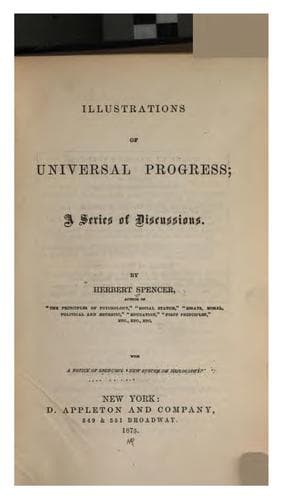
Illustrations of Universal Progress: A Series of DiscussionsSpencer, Herbert
Philosophy
Illustrations of Universal Progress: A Series of Discussions
Spencer, Herbert
Philosophy; Political science; Science
Here then we have _inorganic physics_ clearly divided into _celestial
physics_ and _terrestrial physics_--the phenomena presented by the
universe, and the phenomena presented by earthly bodies. If now celestial
bodies and terrestrial bodies exhibit sundry leading phenomena in common,
as they do, how can the generalization of these common phenomena be
considered as pertaining to the one class rather than to the other? If
inorganic physics includes geometry (which M. Comte has made it do by
comprehending _geometrical_ astronomy in its sub-section--celestial
physics); and if its sub-section--terrestrial physics, treats of things
having geometrical properties; how can the laws of geometrical relations be
excluded from terrestrial physics? Clearly if celestial physics includes
the geometry of objects in the heavens, terrestrial physics includes the
geometry of objects on the earth. And if terrestrial physics includes
terrestrial geometry, while celestial physics includes celestial geometry,
then the geometrical part of terrestrial physics precedes the geometrical
part of celestial physics; seeing that geometry gained its first ideas from
surrounding objects. Until men had learnt geometrical relations from bodies
on the earth, it was impossible for them to understand the geometrical
relations of bodies in the heavens.
So, too, with celestial mechanics, which had terrestrial mechanics for its
parent. The very conception of _force_, which underlies the whole of
mechanical astronomy, is borrowed from our earthly experiences; and the
leading laws of mechanical action as exhibited in scales, levers,
projectiles, &c., had to be ascertained before the dynamics of the solar
system could be entered upon. What were the laws made use of by Newton in
working out his grand discovery? The law of falling bodies disclosed by
Galileo; that of the composition of forces also disclosed by Galileo; and
that of centrifugal force found out by Huyghens--all of them
generalizations of terrestrial physics. Yet, with facts like these before
him, M. Comte places astronomy before physics in order of evolution! He
does not compare the geometrical parts of the two together, and the
mechanical parts of the two together; for this would by no means suit his
hypothesis. But he compares the geometrical part of the one with the
mechanical part of the other, and so gives a semblance of truth to his
position. He is led away by a verbal delusion. Had he confined his
attention to the things and disregarded the words, he would have seen that
before mankind scientifically co-ordinated _any one class of phenomena_
displayed in the heavens, they had previously co-ordinated _a parallel
class of phenomena_ displayed upon the surface of the earth.
Public-domain text, read in full here on John Shaqi.
Reviews
Reviews
No reviews yet
Be the first to share your thoughts on this work.
Elsewhere in the archive
Join the Discussion
Join the discussion
Sign in to leave a comment or review.
Sign InorCreate an account