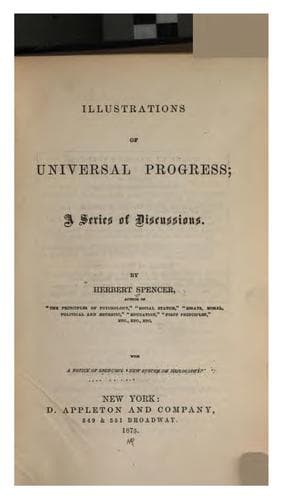
Illustrations of Universal Progress: A Series of DiscussionsSpencer, Herbert
Philosophy
Illustrations of Universal Progress: A Series of Discussions
Spencer, Herbert
Philosophy; Political science; Science
Were it needful we could fill a score pages with the incongruities of M.
Comte's scheme. But the foregoing samples will suffice. So far is his law
of evolution of the sciences from being tenable, that, by following his
example, and arbitrarily ignoring one class of facts, it would be possible
to present, with great plausibility, just the opposite generalization to
that which he enunciates. While he asserts that the rational order of the
sciences, like the order of their historic development, "is determined by
the degree of simplicity, or, what comes to the same thing, of generality
of their phenomena;" it might contrariwise be asserted, that, commencing
with the complex and the special, mankind have progressed step by step to a
knowledge of greater simplicity and wider generality. So much evidence is
there of this as to have drawn from Whewell, in his _History of the
Inductive Sciences_, the general remark that "the reader has already seen
repeatedly in the course of this history, complex and derivative principles
presenting themselves to men's minds before simple and elementary ones."
Even from M. Comte's own work, numerous facts, admissions, and arguments,
might be picked out, tending to show this. We have already quoted his words
in proof that both abstract and concrete mathematics have progressed
towards a higher degree of generality, and that he looks forward to a
higher generality still. Just to strengthen this adverse hypothesis, let us
take a further instance. From the _particular_ case of the scales, the law
of equilibrium of which was familiar to the earliest nations known,
Archimedes advanced to the more _general_ case of the unequal lever with
unequal weights; the law of equilibrium of which _includes_ that of the
scales. By the help of Galileo's discovery concerning the composition of
forces, D'Alembert "established, for the first time, the equations of
equilibrium of _any_ system of forces applied to the different points of a
solid body"--equations which include all cases of levers and an infinity of
cases besides. Clearly this is progress towards a higher
generality--towards a knowledge more independent of special
circumstances--towards a study of phenomena "the most disengaged from the
incidents of particular cases;" which is M. Comte's definition of "the most
simple phenomena." Does it not indeed follow from the familiarly admitted
fact, that mental advance is from the concrete to the abstract, from the
particular to the general, that the universal and therefore most simple
truths are the last to be discovered? Is not the government of the solar
system by a force varying inversely as the square of the distance, a
simpler conception than any that preceded it? Should we ever succeed in
reducing all orders of phenomena to some single law--say of atomic action,
as M. Comte suggests--must not that law answer to his test of being
_independent_ of all others, and therefore most simple? And would not such
Public-domain text, read in full here on John Shaqi.
Reviews
Reviews
No reviews yet
Be the first to share your thoughts on this work.
Elsewhere in the archive
Join the Discussion
Join the discussion
Sign in to leave a comment or review.
Sign InorCreate an account