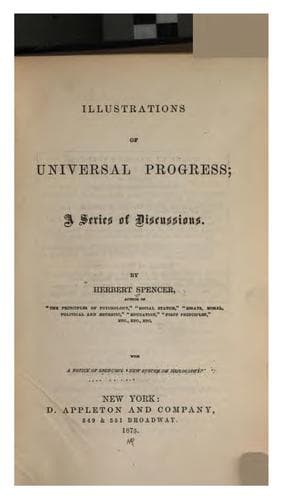
Illustrations of Universal Progress: A Series of DiscussionsSpencer, Herbert
Philosophy
Illustrations of Universal Progress: A Series of Discussions
Spencer, Herbert
Philosophy; Political science; Science
a law generalize the phenomena of gravity, cohesion, atomic affinity, and
electric repulsion, just as the laws of number generalize the quantitative
phenomena of space, time and force?
The possibility of saying so much in support of an hypothesis the very
reverse of M. Comte's, at once proves that his generalization is only a
half-truth. The fact is, that neither proposition is correct by itself; and
the actuality is expressed only by putting the two together. The progress
of science is duplex: it is at once from the special to the general, and
from the general to the special: it is analytical and synthetical at the
same time.
M. Comte himself observes that the evolution of science has been
accomplished by the division of labour; but he quite misstates the mode in
which this division of labour has operated. As he describes it, it has
simply been an arrangement of phenomena into classes, and the study of each
class by itself. He does not recognise the constant effect of progress in
each class upon _all_ other classes; but only on the class succeeding it in
his hierarchical scale. Or if he occasionally admits collateral influences
and intercommunications, he does it so grudgingly, and so quickly puts the
admissions out of sight and forgets them, as to leave the impression that,
with but trifling exceptions, the sciences aid each other only in the order
of their alleged succession. The fact is, however, that the division of
labour in science, like the division of labour in society, and like the
"physiological division of labour" in individual organisms, has been not
only a specialization of functions, but a continuous helping of each
division by all the others, and of all by each. Every particular class of
inquirers has, as it were, secreted its own particular order of truths from
the general mass of material which observation accumulates; and all other
classes of inquirers have made use of these truths as fast as they were
elaborated, with the effect of enabling them the better to elaborate each
its own order of truths.
Public-domain text, read in full here on John Shaqi.
Reviews
Reviews
No reviews yet
Be the first to share your thoughts on this work.
Elsewhere in the archive
Join the Discussion
Join the discussion
Sign in to leave a comment or review.
Sign InorCreate an account