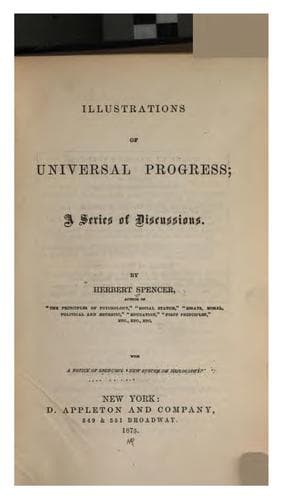
Illustrations of Universal Progress: A Series of DiscussionsSpencer, Herbert
Philosophy
Illustrations of Universal Progress: A Series of Discussions
Spencer, Herbert
Philosophy; Political science; Science
For German philosophers, who hold that Nature is "petrified intelligence,"
and that logical forms are the foundations of all things, it is a
consistent hypothesis that as thought is serial, Nature is serial; but that
M. Comte, who is so bitter an opponent of all anthropomorphism, even in its
most evanescent shapes, should have committed the mistake of imposing upon
the external world an arrangement which so obviously springs from a
limitation of the human consciousness, is somewhat strange. And it is the
more strange when we call to mind how, at the outset, M. Comte remarks that
in the beginning "_toutes les sciences sont cultivees simultanement par les
memes esprits_;" that this is "_inevitable et meme indispensable_;" and how
he further remarks that the different sciences are "_comme les diverses
branches d'un tronc unique_." Were it not accounted for by the distorting
influence of a cherished hypothesis, it would be scarcely possible to
understand how, after recognising truths like these, M. Comte should have
persisted in attempting to construct "_une echelle encyclopedique_."
The metaphor which M. Comte has here so inconsistently used to express the
relations of the sciences--branches of one trunk--is an approximation to
the truth, though not the truth itself. It suggests the facts that the
sciences had a common origin; that they have been developing
simultaneously; and that they have been from time to time dividing and
sub-dividing. But it does not suggest the yet more important fact, that the
divisions and sub-divisions thus arising do not remain separate, but now
and again re-unite in direct and indirect ways. They inosculate; they
severally send off and receive connecting growths; and the intercommunion
has been ever becoming more frequent, more intricate, more widely ramified.
There has all along been higher specialization, that there might be a
larger generalization; and a deeper analysis, that there might be a better
synthesis. Each larger generalization has lifted sundry specializations
still higher; and each better synthesis has prepared the way for still
deeper analysis.
And here we may fitly enter upon the task awhile since indicated--a sketch
of the Genesis of Science, regarded as a gradual outgrowth from common
knowledge--an extension of the perceptions by the aid of the reason. We
propose to treat it as a psychological process historically displayed;
tracing at the same time the advance from qualitative to quantitative
prevision; the progress from concrete facts to abstract facts, and the
application of such abstract facts to the analysis of new orders of
concrete facts; the simultaneous advance in generalization and
specialization; the continually increasing subdivision and reunion of the
sciences; and their constantly improving _consensus_.
* * * * *
Public-domain text, read in full here on John Shaqi.
Reviews
Reviews
No reviews yet
Be the first to share your thoughts on this work.
Elsewhere in the archive
Join the Discussion
Join the discussion
Sign in to leave a comment or review.
Sign InorCreate an account