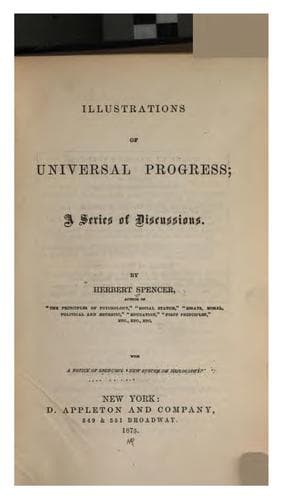
Illustrations of Universal Progress: A Series of DiscussionsSpencer, Herbert
Philosophy
Illustrations of Universal Progress: A Series of Discussions
Spencer, Herbert
Philosophy; Political science; Science
To trace out scientific evolution from its deepest roots would, of course,
involve a complete analysis of the mind. For as science is a development of
that common knowledge acquired by the unaided senses and uncultured reason,
so is that common knowledge itself gradually built up out of the simplest
perceptions. We must, therefore, begin somewhere abruptly; and the most
appropriate stage to take for our point of departure will be the adult mind
of the savage.
Commencing thus, without a proper preliminary analysis, we are naturally
somewhat at a loss how to present, in a satisfactory manner, those
fundamental processes of thought out of which science ultimately
originates. Perhaps our argument may be best initiated by the proposition,
that all intelligent action whatever depends upon the discerning of
distinctions among surrounding things. The condition under which only it is
possible for any creature to obtain food and avoid danger is, that it shall
be differently affected by different objects--that it shall be led to act
in one way by one object, and in another way by another. In the lower
orders of creatures this condition is fulfilled by means of an apparatus
which acts automatically. In the higher orders the actions are partly
automatic, partly conscious. And in man they are almost wholly conscious.
Throughout, however, there must necessarily exist a certain classification
of things according to their properties--a classification which is either
organically registered in the system, as in the inferior creation, or is
formed by experience, as in ourselves. And it may be further remarked, that
the extent to which this classification is carried, roughly indicates the
height of intelligence--that, while the lowest organisms are able to do
little more than discriminate organic from inorganic matter; while the
generality of animals carry their classifications no further than to a
limited number of plants or creatures serving for food, a limited number of
beasts of prey, and a limited number of places and materials; the most
degraded of the human race possess a knowledge of the distinctive natures
of a great variety of substances, plants, animals, tools, persons, &c., not
only as classes but as individuals.
Public-domain text, read in full here on John Shaqi.
Reviews
Reviews
No reviews yet
Be the first to share your thoughts on this work.
Elsewhere in the archive
Join the Discussion
Join the discussion
Sign in to leave a comment or review.
Sign InorCreate an account