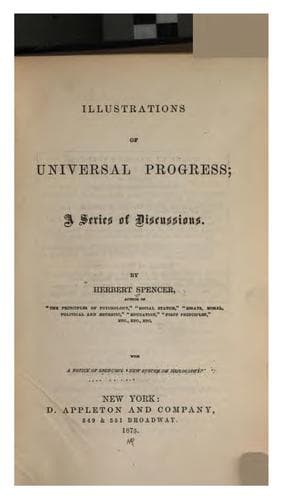
Illustrations of Universal Progress: A Series of DiscussionsSpencer, Herbert
Philosophy
Illustrations of Universal Progress: A Series of Discussions
Spencer, Herbert
Philosophy; Political science; Science
Let us next notice that the recognition of likeness and unlikeness, which
underlies classification, and out of which continued classification evolves
the idea of complete likeness--let us next notice that it also underlies
the process of _naming_, and by consequence _language_. For all language
consists, at the beginning, of symbols which are as _like_ to the things
symbolized as it is practicable to make them. The language of signs is a
means of conveying ideas by mimicking the actions or peculiarities of the
things referred to. Verbal language is also, at the beginning, a mode of
suggesting objects or acts by imitating the sounds which the objects make,
or with which the acts are accompanied. Originally these two languages were
used simultaneously. It needs but to watch the gesticulations with which
the savage accompanies his speech--to see a Bushman or a Kaffir dramatizing
before an audience his mode of catching game--or to note the extreme
paucity of words in all primitive vocabularies; to infer that at first,
attitudes, gestures, and sounds, were all combined to produce as good a
_likeness_ as possible, of the things, animals, persons, or events
described; and that as the sounds came to be understood by themselves the
gestures fell into disuse: leaving traces, however, in the manners of the
more excitable civilized races. But be this as it may, it suffices simply
to observe, how many of the words current among barbarous peoples are like
the sounds appertaining to the things signified; how many of our own oldest
and simplest words have the same peculiarity; how children tend to invent
imitative words; and how the sign-language spontaneously formed by deaf
mutes is invariably based upon imitative actions--to at once see that the
notion of _likeness_ is that from which the nomenclature of objects takes
its rise.
Were there space we might go on to point out how this law of life is
traceable, not only in the origin but in the development of language; how
in primitive tongues the plural is made by a duplication of the singular,
which is a multiplication of the word to make it _like_ the multiplicity of
the things; how the use of metaphor--that prolific source of new words--is
a suggesting of ideas that are _like_ the ideas to be conveyed in some
respect or other; and how, in the copious use of simile, fable, and
allegory among uncivilized races, we see that complex conceptions, which
there is yet no direct language for, are rendered, by presenting known
conceptions more or less _like_ them.
Public-domain text, read in full here on John Shaqi.
Reviews
Reviews
No reviews yet
Be the first to share your thoughts on this work.
Elsewhere in the archive
Join the Discussion
Join the discussion
Sign in to leave a comment or review.
Sign InorCreate an account