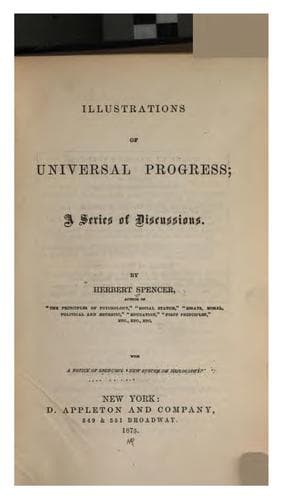
Illustrations of Universal Progress: A Series of DiscussionsSpencer, Herbert
Philosophy
Illustrations of Universal Progress: A Series of Discussions
Spencer, Herbert
Philosophy; Political science; Science
This view is further confirmed, and the predominance of this notion of
likeness in primitive times further illustrated, by the fact that our
system of presenting ideas to the eye originated after the same fashion.
Writing and printing have descended from picture-language. The earliest
mode of permanently registering a fact was by depicting it on a wall; that
is--by exhibiting something as _like_ to the thing to be remembered as it
could be made. Gradually as the practice grew habitual and extensive, the
most frequently repeated forms became fixed, and presently abbreviated;
and, passing through the hieroglyphic and ideographic phases, the symbols
lost all apparent relations to the things signified: just as the majority
of our spoken words have done.
Observe again, that the same thing is true respecting the genesis of
reasoning. The _likeness_ that is perceived to exist between cases, is the
essence of all early reasoning and of much of our present reasoning. The
savage, having by experience discovered a relation between a certain object
and a certain act, infers that the _like_ relation will be found in future
cases. And the expressions we constantly use in our arguments--"_analogy_
implies," "the cases are not _parallel_," "by _parity_ of reasoning,"
"there is no _similarity_,"--show how constantly the idea of likeness
underlies our ratiocinative processes.
Still more clearly will this be seen on recognising the fact that there is
a certain parallelism between reasoning and classification; that the two
have a common root; and that neither can go on without the other. For on
the one hand, it is a familiar truth that the attributing to a body in
consequence of some of its properties, all those other properties in virtue
of which it is referred to a particular class, is an act of inference. And,
on the other hand, the forming of a generalization is the putting together
in one class, all those cases which present like relations; while the
drawing a deduction is essentially the perception that a particular case
belongs to a certain class of cases previously generalized. So that as
classification is a grouping together of _like things_; reasoning is a
grouping together of _like relations_ among things. Add to which, that
while the perfection gradually achieved in classification consists in the
formation of groups of _objects_ which are _completely alike_; the
perfection gradually achieved in reasoning consists in the formation of
groups of _cases_ which are _completely alike_.
Public-domain text, read in full here on John Shaqi.
Reviews
Reviews
No reviews yet
Be the first to share your thoughts on this work.
Elsewhere in the archive
Join the Discussion
Join the discussion
Sign in to leave a comment or review.
Sign InorCreate an account