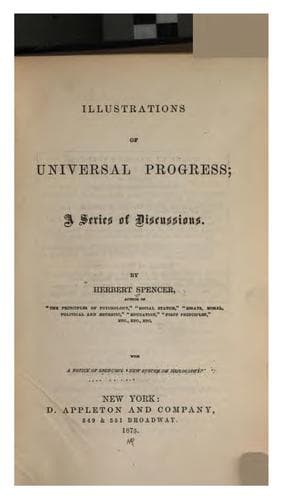
Illustrations of Universal Progress: A Series of DiscussionsSpencer, Herbert
Philosophy
Illustrations of Universal Progress: A Series of Discussions
Spencer, Herbert
Philosophy; Political science; Science
Those who cannot understand how the recognition of similarity in creatures
of the same kind, can have any alliance with reasoning, will get over the
difficulty on remembering that the phenomena among which equality of
relations is thus perceived, are phenomena of the same order and are
present to the senses at the same time; while those among which developed
reason perceives relations, are generally neither of the same order, nor
simultaneously present. And if further, they will call to mind how Cuvier
and Owen, from a single part of a creature, as a tooth, construct the rest
by a process of reasoning based on this equality of relations, they will
see that the two things are intimately connected, remote as they at first
seem. But we anticipate. What it concerns us here to observe is, that from
familiarity with organic forms there simultaneously arose the ideas of
_simple equality_, and _equality of relations_.
At the same time, too, and out of the same mental processes, came the first
distinct ideas of _number_. In the earliest stages, the presentation of
several like objects produced merely an indefinite conception of
multiplicity; as it still does among Australians, and Bushmen, and Damaras,
when the number presented exceeds three or four. With such a fact before us
we may safely infer that the first clear numerical conception was that of
duality as contrasted with unity. And this notion of duality must
necessarily have grown up side by side with those of likeness and equality;
seeing that it is impossible to recognise the likeness of two things
without also perceiving that there are two. From the very beginning the
conception of number must have been, as it is still, associated with the
likeness or equality of the things numbered. If we analyze it, we find that
simple enumeration is a registration of repeated impressions of any kind.
That these may be capable of enumeration it is needful that they be more or
less alike; and before any _absolutely true_ numerical results can be
reached, it is requisite that the units be _absolutely equal_. The only way
in which we can establish a numerical relationship between things that do
not yield us like impressions, is to divide them into parts that _do_ yield
us like impressions. Two unlike magnitudes of extension, force, time,
weight, or what not, can have their relative amounts estimated, only by
means of some small unit that is contained many times in both; and even if
we finally write down the greater one as a unit and the other as a fraction
of it, we state, in the denominator of the fraction, the number of parts
into which the unit must be divided to be comparable with the fraction.
Public-domain text, read in full here on John Shaqi.
Reviews
Reviews
No reviews yet
Be the first to share your thoughts on this work.
Elsewhere in the archive
Join the Discussion
Join the discussion
Sign in to leave a comment or review.
Sign InorCreate an account