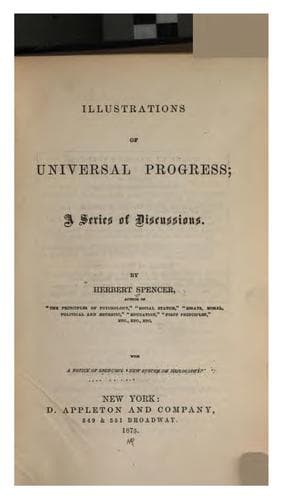
Illustrations of Universal Progress: A Series of DiscussionsSpencer, Herbert
Philosophy
Illustrations of Universal Progress: A Series of Discussions
Spencer, Herbert
Philosophy; Political science; Science
It is, indeed, true, that by an evidently modern process of abstraction, we
occasionally apply numbers to unequal units, as the furniture at a sale or
the various animals on a farm, simply as so many separate entities; but no
true result can be brought out by calculation with units of this order.
And, indeed, it is the distinctive peculiarity of the calculus in general,
that it proceeds on the hypothesis of that absolute equality of its
abstract units, which no real units possess; and that the exactness of its
results holds only in virtue of this hypothesis. The first ideas of number
must necessarily then have been derived from like or equal magnitudes as
seen chiefly in organic objects; and as the like magnitudes most frequently
observed were magnitudes of extension, it follows that geometry and
arithmetic had a simultaneous origin.
Not only are the first distinct ideas of number co-ordinate with ideas of
likeness and equality, but the first efforts at numeration displayed the
same relationship. On reading the accounts of various savage tribes, we
find that the method of counting by the fingers, still followed by many
children, is the aboriginal method. Neglecting the several cases in which
the ability to enumerate does not reach even to the number of fingers on
one hand, there are many cases in which it does not extend beyond ten--the
limit of the simple finger notation. The fact that in so many instances,
remote, and seemingly unrelated nations, have adopted _ten_ as their basic
number; together with the fact that in the remaining instances the basic
number is either _five_ (the fingers of one hand) or _twenty_ (the fingers
and toes); almost of themselves show that the fingers were the original
units of numeration. The still surviving use of the word _digit_, as the
general name for a figure in arithmetic, is significant; and it is even
said that our word _ten_ (Sax. tyn; Dutch, tien; German, zehn) means in its
primitive expanded form _two hands_. So that originally, to say there were
ten things, was to say there were two hands of them.
From all which evidence it is tolerably clear that the earliest mode of
conveying the idea of any number of things, was by holding up as many
fingers as there were things; that is--using a symbol which was _equal_, in
respect of multiplicity, to the group symbolized. For which inference there
is, indeed, strong confirmation in the recent statement that our own
soldiers are even now spontaneously adopting this device in their dealings
with the Turks. And here it should be remarked that in this recombination
of the notion of equality with that of multiplicity, by which the first
steps in numeration are effected, we may see one of the earliest of those
inosculations between the diverging branches of science, which are
afterwards of perpetual occurrence.
Public-domain text, read in full here on John Shaqi.
Reviews
Reviews
No reviews yet
Be the first to share your thoughts on this work.
Elsewhere in the archive
Join the Discussion
Join the discussion
Sign in to leave a comment or review.
Sign InorCreate an account