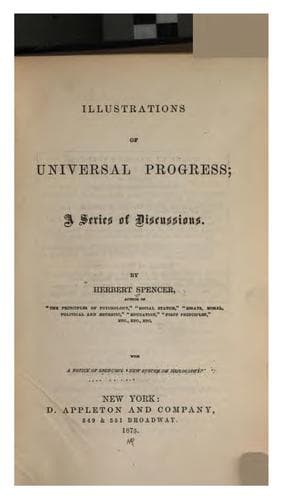
Illustrations of Universal Progress: A Series of DiscussionsSpencer, Herbert
Philosophy
Illustrations of Universal Progress: A Series of Discussions
Spencer, Herbert
Philosophy; Political science; Science
But how came the transition from those uncertain perceptions of equality
which the unaided senses give, to the certain ones with which science
deals? It came by placing the things compared in juxtaposition. Equality
being predicated of things which give us indistinguishable impressions, and
no accurate comparison of impressions being possible unless they occur in
immediate succession, it results that exactness of equality is
ascertainable in proportion to the closeness of the compared things. Hence
the fact that when we wish to judge of two shades of colour whether they
are alike or not, we place them side by side; hence the fact that we
cannot, with any precision, say which of two allied sounds is the louder,
or the higher in pitch, unless we hear the one immediately after the other;
hence the fact that to estimate the ratio of weights, we take one in each
hand, that we may compare their pressures by rapidly alternating in thought
from the one to the other; hence the fact, that in a piece of music, we can
continue to make equal beats when the first beat has been given, but cannot
ensure commencing with the same length of beat on a future occasion; and
hence, lastly, the fact, that of all magnitudes, those of _linear
extension_ are those of which the equality is most accurately
ascertainable, and those to which by consequence all others have to be
reduced. For it is the peculiarity of linear extension that it alone allows
its magnitudes to be placed in _absolute_ juxtaposition, or, rather, in
coincident position; it alone can test the equality of two magnitudes by
observing whether they will coalesce, as two equal mathematical lines do,
when placed between the same points; it alone can test _equality_ by trying
whether it will become _identity_. Hence, then, the fact, that all exact
science is reducible, by an ultimate analysis, to results measured in equal
units of linear extension.
Public-domain text, read in full here on John Shaqi.
Reviews
Reviews
No reviews yet
Be the first to share your thoughts on this work.
Elsewhere in the archive
Join the Discussion
Join the discussion
Sign in to leave a comment or review.
Sign InorCreate an account