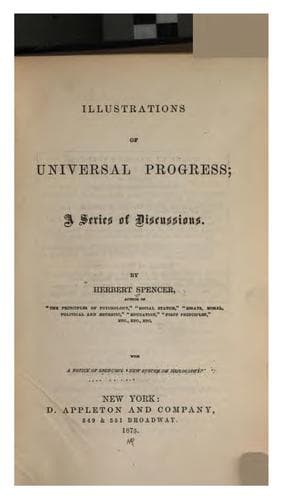
Illustrations of Universal Progress: A Series of DiscussionsSpencer, Herbert
Philosophy
Illustrations of Universal Progress: A Series of Discussions
Spencer, Herbert
Philosophy; Political science; Science
Equality, once having come to be definitely conceived, was readily
applicable to other phenomena than those of magnitude. Being predicable of
all things producing indistinguishable impressions, there naturally grew up
ideas of equality in weights, sounds, colours, &c.; and indeed it can
scarcely be doubted that the occasional experience of equal weights,
sounds, and colours, had a share in developing the abstract conception of
equality--that the ideas of equality in size, relations, forces,
resistances, and sensible properties in general, were evolved during the
same period. But however this may be, it is clear that as fast as the
notion of equality gained definiteness, so fast did that lowest kind of
quantitative prevision which is achieved without any instrumental aid,
become possible.
The ability to estimate, however roughly, the amount of a foreseen result,
implies the conception that it will be _equal to_ a certain imagined
quantity; and the correctness of the estimate will manifestly depend upon
the accuracy at which the perceptions of sensible equality have arrived. A
savage with a piece of stone in his hand, and another piece lying before
him of greater bulk but of the same kind (a fact which he infers from the
_equality_ of the two in colour and texture) knows about what effort he
must put forth to raise this other piece; and he judges accurately in
proportion to the accuracy with which he perceives that the one is twice,
three times, four times, &c. as large as the other; that is--in proportion
to the precision of his ideas of equality and number. And here let us not
omit to notice that even in these vaguest of quantitative previsions, the
conception of _equality of relations_ is also involved. For it is only in
virtue of an undefined perception that the relation between bulk and weight
in the one stone is _equal_ to the relation between bulk and weight in the
other, that even the roughest approximation can be made.
Public-domain text, read in full here on John Shaqi.
Reviews
Reviews
No reviews yet
Be the first to share your thoughts on this work.
Elsewhere in the archive
Join the Discussion
Join the discussion
Sign in to leave a comment or review.
Sign InorCreate an account