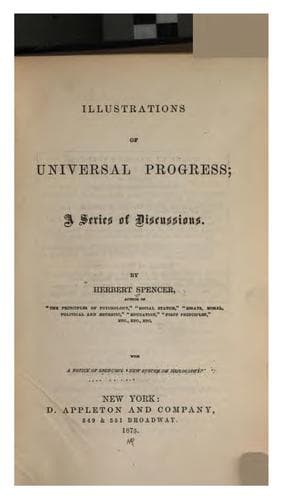
Illustrations of Universal Progress: A Series of DiscussionsSpencer, Herbert
Philosophy
Illustrations of Universal Progress: A Series of Discussions
Spencer, Herbert
Philosophy; Political science; Science
Not only must abstract mathematics have made some progress, but concrete
mathematics also. It is scarcely possible that the buildings belonging to
this era should have been laid out and erected without any knowledge of
geometry. At any rate, there must have existed that elementary geometry
which deals with direct measurement--with the apposition of lines; and it
seems that only after the discovery of those simple proceedings, by which
right angles are drawn, and relative positions fixed, could so regular an
architecture be executed. In the case of the other division of concrete
mathematics--mechanics, we have definite evidence of progress. We know that
the lever and the inclined plane were employed during this period: implying
that there was a qualitative prevision of their effects, though not a
quantitative one. But we know more. We read of weights in the earliest
records; and we find weights in ruins of the highest antiquity. Weights
imply scales, of which we have also mention; and scales involve the primary
theorem of mechanics in its least complicated form--involve not a
qualitative but a quantitative prevision of mechanical effects. And here we
may notice how mechanics, in common with the other exact sciences, took its
rise from the simplest application of the idea of _equality_. For the
mechanical proposition which the scales involve, is, that if a lever with
_equal_ arms, have _equal_ weights suspended from them, the weights will
remain at _equal_ altitudes. And we may further notice, how, in this first
step of rational mechanics, we see illustrated that truth awhile since
referred to, that as magnitudes of linear extension are the only ones of
which the equality is exactly ascertainable, the equalities of other
magnitudes have at the outset to be determined by means of them. For the
equality of the weights which balance each other in scales, wholly depends
upon the equality of the arms: we can know that the weights are equal only
by proving that the arms are equal. And when by this means we have obtained
a system of weights,--a set of equal units of force, then does a science of
mechanics become possible. Whence, indeed, it follows, that rational
mechanics could not possibly have any other starting-point than the scales.
Public-domain text, read in full here on John Shaqi.
Reviews
Reviews
No reviews yet
Be the first to share your thoughts on this work.
Elsewhere in the archive
Join the Discussion
Join the discussion
Sign in to leave a comment or review.
Sign InorCreate an account