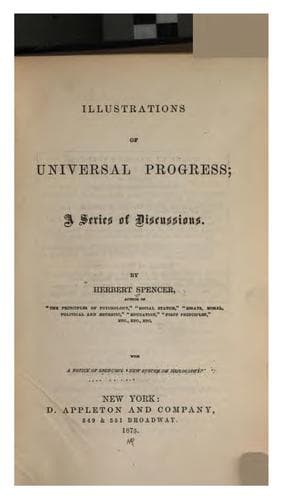
Illustrations of Universal Progress: A Series of DiscussionsSpencer, Herbert
Philosophy
Illustrations of Universal Progress: A Series of Discussions
Spencer, Herbert
Philosophy; Political science; Science
Let us further remember, that during this same period there was a limited
knowledge of chemistry. The many arts which we know to have been carried on
must have been impossible without a generalized experience of the modes in
which certain bodies affect each other under special conditions. In
metallurgy, which was extensively practised, this is abundantly
illustrated. And we even have evidence that in some cases the knowledge
possessed was, in a sense, quantitative. For, as we find by analysis that
the hard alloy of which the Egyptians made their cutting tools, was
composed of copper and tin in fixed proportions, there must have been an
established prevision that such an alloy was to be obtained only by mixing
them in these proportions. It is true, this was but a simple empirical
generalization; but so was the generalization respecting the recurrence of
eclipses; so are the first generalizations of every science.
Respecting the simultaneous advance of the sciences during this early
epoch, it only remains to remark that even the most complex of them must
have made some progress--perhaps even a greater relative progress than any
of the rest. For under what conditions only were the foregoing developments
possible? There first required an established and organized social system.
A long continued registry of eclipses; the building of palaces; the use of
scales; the practice of metallurgy--alike imply a fixed and populous
nation. The existence of such a nation not only presupposes laws, and some
administration of justice, which we know existed, but it presupposes
successful laws--laws conforming in some degree to the conditions of social
stability--laws enacted because it was seen that the actions forbidden by
them were dangerous to the State. We do not by any means say that all, or
even the greater part, of the laws were of this nature; but we do say, that
the fundamental ones were. It cannot be denied that the laws affecting life
and property were such. It cannot be denied that, however little these were
enforced between class and class, they were to a considerable extent
enforced between members of the same class. It can scarcely be questioned,
that the administration of them between members of the same class was seen
by rulers to be necessary for keeping their subjects together. And knowing,
as we do, that, other things equal, nations prosper in proportion to the
justness of their arrangements, we may fairly infer that the very cause of
the advance of these earliest nations out of aboriginal barbarism, was the
greater recognition among them of the claims to life and property.
Public-domain text, read in full here on John Shaqi.
Reviews
Reviews
No reviews yet
Be the first to share your thoughts on this work.
Elsewhere in the archive
Join the Discussion
Join the discussion
Sign in to leave a comment or review.
Sign InorCreate an account