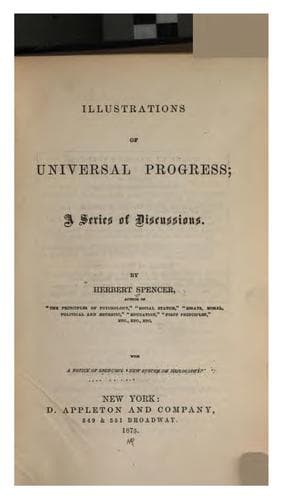
Illustrations of Universal Progress: A Series of DiscussionsSpencer, Herbert
Philosophy
Illustrations of Universal Progress: A Series of Discussions
Spencer, Herbert
Philosophy; Political science; Science
But supposition aside, it is clear that the habitual recognition of these
claims in their laws, implied some prevision of social phenomena. Even thus
early there was a certain amount of social science. Nay, it may even be
shown that there was a vague recognition of that fundamental principle on
which all the true social science is based--the equal rights of all to the
free exercise of their faculties. That same idea of _equality_, which, as
we have seen, underlies all other science, underlies also morals and
sociology. The conception of justice, which is the primary one in morals;
and the administration of justice, which is the vital condition of social
existence; are impossible, without the recognition of a certain likeness in
men's claims, in virtue of their common humanity. _Equity_ literally means
_equalness_; and if it be admitted that there were even the vaguest ideas
of equity in these primitive eras, it must be admitted that there was some
appreciation of the equalness of men's liberties to pursue the objects of
life--some appreciation, therefore, of the essential principle of national
equilibrium.
Thus in this initial stage of the positive sciences, before geometry had
yet done more than evolve a few empirical rules--before mechanics had
passed beyond its first theorem--before astronomy had advanced from its
merely chronological phase into the geometrical; the most involved of the
sciences had reached a certain degree of development--a development without
which no progress in other sciences was possible.
Only noting as we pass, how, thus early, we may see that the progress of
exact science was not only towards an increasing number of previsions, but
towards previsions more accurately quantitative--how, in astronomy, the
recurring period of the moon's motions was by and by more correctly
ascertained to be nineteen years, or two hundred and thirty-five lunations;
how Callipus further corrected this Metonic cycle, by leaving out a day at
the end of every seventy-six years; and how these successive advances
implied a longer continued registry of observations, and the co-ordination
of a greater number of facts--let us go on to inquire how geometrical
astronomy took its rise.
Public-domain text, read in full here on John Shaqi.
Reviews
Reviews
No reviews yet
Be the first to share your thoughts on this work.
Elsewhere in the archive
Join the Discussion
Join the discussion
Sign in to leave a comment or review.
Sign InorCreate an account