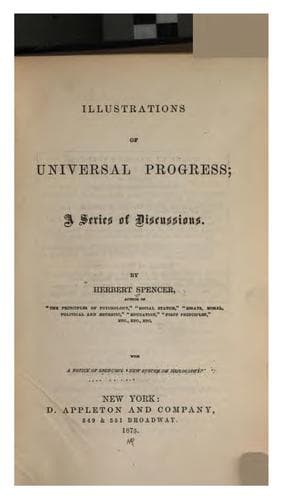
Illustrations of Universal Progress: A Series of DiscussionsSpencer, Herbert
Philosophy
Illustrations of Universal Progress: A Series of Discussions
Spencer, Herbert
Philosophy; Political science; Science
than that of the precession of the equinoxes--but that the relatively slow
advance of chemical knowledge was due, partly to the fact that its
phenomena were not daily thrust on men's notice as those of astronomy were;
partly to the fact that Nature does not habitually supply the means, and
suggest the modes of investigation, as in the sciences dealing with time,
extension, and force; and partly to the fact that the great majority of the
materials with which chemistry deals, instead of being ready to hand, are
made known only by the arts in their slow growth; and partly to the fact
that even when known, their chemical properties are not self-exhibited, but
have to be sought out by experiment.
Merely indicating all these considerations, however, let us go on to
contemplate the progress and mutual influence of the sciences in modern
days; only parenthetically noticing how, on the revival of the scientific
spirit, the successive stages achieved exhibit the dominance of the same
law hitherto traced--how the primary idea in dynamics, a uniform force, was
defined by Galileo to be a force which generates _equal_ velocities in
_equal_ successive times--how the uniform action of gravity was first
experimentally determined by showing that the time elapsing before a body
thrown up, stopped, was _equal_ to the time it took to fall--how the first
fact in compound motion which Galileo ascertained was, that a body
projected horizontally will have a uniform motion onwards and a uniformly
accelerated motion downwards; that is, will describe _equal_ horizontal
spaces in _equal_ times, compounded with _equal_ vertical increments in
_equal_ times--how his discovery respecting the pendulum was, that its
oscillations occupy _equal_ intervals of time whatever their length--how
the principle of virtual velocities which he established is, that in any
machine the weights that balance each other, are reciprocally as their
virtual velocities; that is, the relation of one set of weights to their
velocities _equals_ the relation of the other set of velocities to their
weights;--and how thus his achievements consisted in showing the equalities
of certain magnitudes and relations, whose equalities had not been
previously recognised.
Public-domain text, read in full here on John Shaqi.
Reviews
Reviews
No reviews yet
Be the first to share your thoughts on this work.
Elsewhere in the archive
Join the Discussion
Join the discussion
Sign in to leave a comment or review.
Sign InorCreate an account